Mistral Large 4
mistral.ai
[274 comments hidden]
Also strong on cyber benchmarks (better than all chinese models), so this is a good defender model.
Lots of people shitting of Mistral for no reason imo. These are pretty good numbers across the board. Definitely good enough to use as a daily driver over other llms, if you have moral qualms with the others. For certain use cases, like cyber security, this may be the go to model.
I like to make fun of europe, but there's lots for mistral to be proud about in this release imo.
[269 comments hidden]
[97 comments hidden]
Edit: unfortunately, it's a question that voting does not really permit you to answer on this website.
[55 comments hidden]
[hidden]
[29 comments hidden]
When you are in the 75%ish of the US, it's very easy to make a case that life in the US is better. But we don't really talk about that because it's pretty taboo when poorer people are struggling much more than they would in Europe.
[19 comments hidden]
[4 comments hidden]
[hidden]
Americans don't have vacation in the same way Scandinavian countries don't have a minimum wage. Even the most left-leaning States in the US have not written it into law because it is effectively addressed by custom. Americans are sufficiently happy with it that vacation isn't a political topic.
[hidden]
Again, the deal with the US is that the rich live better and the poor live worse. Or put another way; people who make money get to keep more, and people who don't make money are given less.
Because there are so many more people who have money, and because those people like living comfortably, available healthcare and education is world class. Make sure not to read that as "All healthcare and education", it's "available healthcare and education".
Generally people who are earning a lot don't care as much about vacation, but every white collar job will generally give at least a standard 15 days off and 10 holidays. Ironically as you move up you are generally given more vacation while actually using less.
[hidden]
Even poor populations worldwide have access to the 3 things you described, but the quality is lower.
European decline has been mentioned since the 1930s.
[10 comments hidden]
Median wealth per adult has the USA at #28, below Italy, Spain, Slovenia, and Portugal.
[9 comments hidden]
USA 25th percentile 28k to 30k EU-27 50th percentile 24k to 26k.
[5 comments hidden]
[hidden]
No, sorry, it isn't. People commonly use the phrase "has money" to refer to income in American English.
[3 comments hidden]
[hidden]
I doubt that; I expect a European on 24k is living better than an American on 30k. But that also depends on where: I'm sure 24k will get you farther in, say, Sofia, Bulgaria, than in Paris or Berlin. Same is true of different places in the US.
[hidden]
[hidden]
[8 comments hidden]
20 years ago this was not the case. The minimum wage in some parts of the US is now higher than the average wage in most of Europe.
The US has a population that will always struggle to survive without government assistance. Per multiple US statistical agencies that is about 10-15% of households.
[5 comments hidden]
definitely not in Western Europe.
[4 comments hidden]
These types of minimum wages used to be limited to expensive locales but it is spreading across the US pretty rapidly. Now you see minimum wages rapidly approaching $20/hr in places far enough from a major city that houses still cost $250k.
[2 comments hidden]
If the financials of people in the US are so great, why do the stats of healthcare, student, and general consumer debt look so bleak? Either you all suck a being high income, or it is not the only interesting factor.
[hidden]
This is actually what I think of all of you guys. Americans completely suck at being high income. They have so much money and yet they waste it. Zero care for efficiency whatsoever.
Edit: Making housing and healthcare expensive is a policy choice and can easily be averted in so many ways.
[hidden]
Let's talk about that $45k/yr. That's an hourly wage of $21.63. No state in the entirety of the US has a minimum wage that high. The current max is Washington, DC (not a state, but they also set their own) at $18.40, which comes out to under $39k.
That's all for hourly work. In the US, there is no minimum for salaried work. If you agree to be paid $1/yr for your work, that's what you get.
So, the minimum hourly wage where you live is absolutely higher than the US, nearly triple that of much of it.
[hidden]
Even outside the most expensive cities, we have lots of affluent suburbs throughout the US, and I guarantee you those households have to earn quite a bit more than $100k/yr in order to live there.
Good luck if you're a family of four making $100k in one of these places. Well, you aren't in one of those places; you live somewhere much cheaper.
[hidden]
And when one comperes wages - PPP should be used. US is really expensive compared to the most of UE. But even then it is not whole picture. For example I can live comfortably with one car in my household. In US I would need 3.
[20 comments hidden]
[14 comments hidden]
[9 comments hidden]
[5 comments hidden]
I didn't say it'd be easy. I'm just pointing out that only one of the two groups being discussed has a real choice in the matter.
[hidden]
[3 comments hidden]
That's why people compare spending power instead of how much money you earn, because that comparison is meaningless.
[2 comments hidden]
[hidden]
Also at this point both have seen such negative upward trends in housing prices that the assumption that someone placed in the middle class owns a home at all (without any debt attached) is questionable. (But that's just a comment and besides the point)
[hidden]
[4 comments hidden]
[3 comments hidden]
Middle class people from wealthy nations who move to poor countries are relatively rich by the standards of their new country. Middle class people from poor countries who move to rich countries are relatively poor by the standards of their new country.
[2 comments hidden]
If you are middle class in EU and have little savings, moving to US will do the opposite and you would be better off.
Your comparison holds for the inverse: getting most of your quality of life from static wealth.
[5 comments hidden]
Or go visit there.
Even in rich cities, it felt like I was in the lower middle class area in my suburban area.
[2 comments hidden]
Probably dial back your assumptions a little bit. I've earned my opinions just as much as you have.
[2 comments hidden]
High education costs. High healthcare costs. One serious disease or accident can bankrupt you. Buying a house usually means a 30 years loans at 7% so after 10 years you still have 85% of capital left to pay off.
Salaries are higher but everything is more expensive, so in purchasing power parity it's basically the same.
[5 comments hidden]
If it bears fruits and we build ``it'', everyone dies, which is par, also?
[hidden]
[hidden]
[8 comments hidden]
[7 comments hidden]
[hidden]
Not a very rigorous economic argument - besides they also don't share an immigration policy, nor a single currency (Denmark)
[hidden]
[hidden]
Take a look at NLNet vs YC. At NLNet, You set your milestones, do the work and get rewarded.
YC just throws money in the hopes one company is a unicorn. Both support growth, but they're not comparable at all.
[6 comments hidden]
[2 comments hidden]
Every person I have ever spoken to who is not white has told me they experienced more prejudice and racism in Europe than America. (at least the ones who have actual been somewhere in Europe)
America still has areas of hard bigotry but most places are wildly diverse and accepting. The favored EU countries everyone holds up are so white and homogeneous it is comical.
This is not dunking on Europe or any specific country but comparing America to some Scandinavia country rich in oil is an apple to oj situation just like comparing America to China or Saudi would be.
[18 comments hidden]
Maybe you're just bitter?
[2 comments hidden]
Edit - never mind, I'll do it, HDI in order:
Iceland, Norway, Switzerland, Denmark, Germany, Sweden, Netherlands, Belgium, Ireland, Finland, UK, US, Slovenia, Austria, Luxembourg, France, Spain, Czechia, Italy, Greece, Poland, Estonia, Lithuania, Portugal, Croatia, Latvia, Slovakia, Hungary, Bulgaria, Romania, Serbia, Russia, Belarus, Bosnia, Moldova, Ukraine
To put that into context, Moldova is on par with Ecuador, Tonga and Dominican Republic.
The US is a country of roughly 340 million people with an HDI above Austria.
[hidden]
But still. The six US states that score less than 0.9 (i.e. Kentucky, Mississippi et al) are supposedly peers of EU countries like Portugal, Estonia and Croatia, i.e. exactly the places that well-off footloose Americans are choosing to move to (Portugal is packed with well-heeled US refugees).
So apparently HDI does not fully measure quality of life, either.
- https://en.wikipedia.org/wiki/List_of_U.S._states_and_territ...
- https://en.wikipedia.org/wiki/List_of_countries_by_Human_Dev...
[4 comments hidden]
I'm frustrated, not bitter. Americans are acutely aware of falling behind China, and rightly concerned about it. Europe is falling behind Alabama, Mexico, and Brazil, and arrogant about it.
Edit: y'all are supposed to be our moral allies in creating a utopian future with prosperity and world peace. Instead the most likely outcomes seem to be that you'll fade to irrelevancy and rather than compromising between America's vision and Europe's vision, we'll compromise between China's vision and America's vision. We liked your vision more than China's.
[3 comments hidden]
> y'all are supposed to be our moral allies
This all comes across as rather black and white. I don't know why you take this stance. I'm sure you understand that it would be very hard for you to understand Europe as a whole, and judge it, just like it would be hard for me to do this with America.
Regardless, when talking morals, I'm also sure you agree there are numerous examples where America has not held up its end of the moral utopian future of prosperity and world peace.
[9 comments hidden]
I wonder if this is actually true. I see very few Americans taking every possible opportunity to make bombastic statements about how their lives are better than everyone else's (at least on HN). This conversation seems quite asymmetric from my perspective.
> Maybe you're just bitter?
This comes off as psychological projection.
[5 comments hidden]
Very few Americans have any experience about how life is in Europe, while the contrary is much more common.
[4 comments hidden]
[3 comments hidden]
[2 comments hidden]
I'll just say that I don't think the reason is a lack of knowledge and leave it here.
[3 comments hidden]
Your observation: Online, Europeans assert they have a better quality of life than Americans, while Americans do not assert the reverse
Your conclusion: "idk maybe they're lying???"
[hidden]
Funnily enough, you can just change European to American here and that's how many Europeans view Americans. Mostly in terms of the wealth distribution though instead of the overall wealth, and the fact that Americans just blindly claim they're the best in everything without hesitation.
Maybe we should focus on huge, exploitative companies that suck out the wealth from everyday Europeans and Americans instead.
[25 comments hidden]
[2 comments hidden]
[3 comments hidden]
This is Not Even Wrong.
[14 comments hidden]
And as you can probably tell by now, the first amendment in the US is not actually preventing the US government from promoting a specific religion or silencing speech. It's just words on a paper at this point. Look at the actual practice.
Several European countries do a much better job at protecting the rights described in the first amendment to the US constitution.
[11 comments hidden]
Freedom of speech.
> "Look at the actual practice."
The UK does not have that? The situation in the UK is very obtuse. It is confused.
[10 comments hidden]
The UK is not the world's biggest champion of free speech, but I think it's still doing better than the US right now.
[9 comments hidden]
The president also didn't ban the media - he just didn't allow them in the Whitehouse. This is something we're rightly concerned about and pushing back on.
The UK on the other hand, does ban ordinary speech by ordinary people in their homes. It's orders of magnitude worse than the United States, as any cursory examination would show.
[8 comments hidden]
> The president also didn't ban the media - he just didn't allow them in the Whitehouse. This is something we're rightly concerned about and pushing back on.
That's still a ban. It's interfering with the media's ability to report on the government. It's great that you're concerned, but it's still happening.
> The UK on the other hand, does ban ordinary speech by ordinary people in their homes.
In their homes? Do you have examples?
I've never heard of anyone in the UK getting in trouble for criticising the government; it seems to be a time honoured tradition there. Whereas in the US, they now check your social media at the border and might not let you into the country if you've said anything critical of the president.
And there's also the censorship on science, which is every bit as serious as the crackdown on government criticism.
[2 comments hidden]
[hidden]
But note that there can also be legitimate reasons why certain social media posts could be illegal: threats, blackmail, cyberbullying, hate speech, etc. Free speech is never absolute; there are always limits to it; also in the US.
The most important (though not the only) reason why free speech is so important, is that it must always be possible to criticise the government, or powerful people in general. That is the big area where the US is attacking free speech: Trump's fragile ego can't handle criticism, so he leverages his power to deny critics, or even just journalists who ask serious questions, access to the White House. Or to remove them from TV (see Stephen Colbert).
I don't know if anything like that is happening in the UK. Some of the reasons mentioned for arrests sound absolutely ludicrous, it definitely sounds like the police is far overstepping its mandate there. But the figure also seems to include threats and harassment, which I would say make absolute sense to prosecute. I haven't seen any evidence of government criticism getting punished in any way, but it's absolutely possible I've missed it; this was a very brief survey. If so, the UK might well be as bad or worse than the US in this.
[5 comments hidden]
[4 comments hidden]
[3 comments hidden]
[2 comments hidden]
Also, at least here in Brazil, the way the constitution is amended is by patching it. For instance, our constitutional amendment number 115 (https://www.planalto.gov.br/ccivil_03/constituicao/emendas/e...) patches article 5 of the constitution to add protection of personal data as a right. But we wouldn't talk about "amendment 115", we would instead talk about "article 5 item LXXIX of the constitution"; that is, what matters is the patched text, not the law that patched it.
I don't know about other countries, but it wouldn't surprise me if they take a similar approach.
[18 comments hidden]
Well I'm european and... That Switzerland (Europe but not EU) has more companies in the Top 70 by market cap than the entire EU (Switzerland has two, the EU only has ASML) is kinda something that warrants making fun of.
That the biggest European software company is SAP, in 71th position is both sad and tragic: it shows how lame and irrelevant Europe is when it comes to software.
So Europe is nowhere in software and friggin nowhere in hardware: sure it's got ASML but ASML now has officially... Zero customer in Europe. Zero is not much.
Then Japan is at least trying to come back into the game with nano imprint litography. Europe is betting it all on AMSL (which anyway is majoritarily US-owned).
So software: nothing. Hardware: nothing besides ASML.
Overall the EU has six companies in the Top 100 by market cap and they're all, besides ASML, near the bottom of the Top 100.
We could also maybe make a bit fun of how the EU destroyed it's car industry (the main industry in Germany, which is the biggest economy of the union) by handing it all to chinese EVs?
Or what about the US warning the EU, years ago, to not become entirely dependent on Russia for energy? And EU not listening and then seeing its energy price skyrocket when the proverbial shit hit the fan? (Russia attacking Ukraine)
And we could, also, at least make a bit of fun of entire streets in cities like Paris and Brussels that used to have luxury shops and fancy restaurants that are all turned into places selling cheap kebabs? What a great success: I'm sure this one makes the komrades happy. It projects an image of grandeur and success: kebabs.
Or the constant attacks on free speech in the EU. Or the surveillance apparatus that's being put into place.
And let's not forget: there were promises made to Russia to never grow the EU to the east. Then the EU started exciting Russia by saying they'd incorporate Ukraine into the EU: I'm not against that but doing that did trigger a war. And now suddenly the EU is waking up and feeling all warmongering, wanting to dedicate a big percentage of its spending to weapons and tanks and missiles.
The warmongering tiny pet that the EU is is kinda laughable too.
At this point it's more like I don't know what is there left to not make fun of about my EU.
For what's going on is just sad, plain sad.
[6 comments hidden]
16 is still not good enough. That being said none of the 4 companies from Switzerland are in software and hardware. ABB is maybe the closest (data center electricity).
Also Switzerland is a very very rich country. Neutral.
Also other countries like Germany has a lot of small companies that are world leaders in their field. That’s part of Germanys resilience.
[3 comments hidden]
[hidden]
Reminds me of a point I heard about sports statistics. If a given team is reported as having "won 4 out of their last 7 matches", there are good odds that they also won 4 out of their last 8 matches. Also pretty good odds that their seventh-last match was a win, otherwise the stat would be 4 out of 6. (It could also go the reverse direction if the goal is to make it look worse than it is.)
[hidden]
> And let's not forget: there were promises made to Russia to never grow the EU to the east. Then the EU started exciting Russia by saying they'd incorporate Ukraine into the EU: I'm not against that but doing that did trigger a war.
Not to mention that the initiative for joining the EU has always been on the side of new members, against the opposition of many existing members who fear displacement and disruption to their positions inside the union. All the narratives about how the West has been "encroaching" upon Russia depend on denying the obvious fact that the initiative has come from Eastern European capitals, not Brussels or Washington.
[3 comments hidden]
[hidden]
Your taxation was the only thing your otherwise poor country could come up with. And now you only have this little enclave which silently melts away while you get stuck there, scared of the rest of the world.
The Swiss are a special breed. Too small to bark, too small to make an impact, but just small enough for the rest of us to laugh at when some rich dude can't understand why the rest of the world doesn't want to be like that.
You're scared of the world, not one bit interested in making it a better place for all mankind. Wanker
[hidden]
How to get causality backwards 101.
Observation 1: China does something (invest into solar panels, batteries, electric vehciles).
Observation 2: EU Politicians made a far away promise to do it too by 2035.
Observation 3: German car manufacturers do absolutely nothing.
Observation 4: EU politicians softened their targets in 2026.
Wrong Conclusion: EU is to blame for the destruction of the German car industry. The industry should have stayed with ICEs until it disappears and no longer exists.
Correct Conclusion: EU should have beaten and forced the car industry to adapt and beat the Chinese at their own game. This would lose some jobs, but the car industry would remain in Europe.
[5 comments hidden]
[2 comments hidden]
Problem is that we thought the US was 'cool', with US movies, music, digital services, cooler than our own and thus we helped give the US the lead. The US has lost it's coolness though, now we just think it's creepy.
[103 comments hidden]
[8 comments hidden]
[6 comments hidden]
Please, like what? GDPR?
[4 comments hidden]
[3 comments hidden]
And you have no protections from the "much more" bits, unlike in the US.
It's incredible that Europeans today think the culture of privacy is different. American privacy protections (from the government) were born out of European flaws.
The difference is that Europeans love the nanny state regulating private enterprise (GDPR) but never pointing that same effort against itself.
[27 comments hidden]
PATRIOT, FISA and Bush's surveillance programme imho give more powers to certain agencies today already than are codified in EU law.
[2 comments hidden]
That is false. They are not proposals, they are being actively discussed in trilogues which is way way past proposal stage.
Chat control V2 trilogue negotiation was last week and it included mass scanning of messages and private data. Thankfully the EU parliament rejected the idea but every 6 months like clockwork it comes back. The next trilogue is in November.
https://www.patrick-breyer.de/en/chat-control-2-0-trilogue-u...
If this was passed, it would force every single cloud provider and e2e chat provider to keep, filter and pass on your private information to Europol and other security agencies.
[hidden]
[0] https://en.wikisource.org/wiki/Consolidated_version_of_the_T...
Quote:
1. Where reference is made in the Treaties to the ordinary legislative procedure for the adoption of an act, the following procedure shall apply.
2. The Commission shall submit a proposal to the European Parliament and the Council.
First reading
3. The European Parliament shall adopt its position at first reading and communicate it to the Council.
[many more items]
Item 3 hasn’t happened yet.
[23 comments hidden]
This is not true. Whether you believe that FISA courts have teeth, or whether 3 letter agencies abide by the law, in most of Europe you do not even have the pretense of this. UK/FR and to a lesser extent DE are all much worse.
The worst parts of Patriot Act were undone in 2015, and the "F" in FISA stands for "Foreign". Europe continues to push policies like Chat Control and attempt to backdoor/ban E2E encryption for domestic surveillance.
The present day and trajectory in Europe is far far more grim than in the US.
[21 comments hidden]
Some politicians in Europe push for that, until now it has been refused by the others. Unlike in the US, there are many different parties in European countries. And Europe is made of politicians from many parties from many countries.
> The worst parts of Patriot Act were undone in 2015
So the NSA doesn't do any kind of domestic surveillance anymore, is that what you believe?
> the "F" in FISA stands for "Foreign". [...] Europe continues to push policies [...] for domestic surveillance.
So if it's surveilling allies, it's all good in your opinion?
> The present day and trajectory in Europe is far far more grim than in the US.
"Far far"? Do you even realise that Europe is not one single country? The US elected Trump, twice.
[19 comments hidden]
> Some politicians in Europe push for that, until now it has been refused by the others. Unlike in the US, there are many different parties in European countries. And Europe is made of politicians from many parties from many countries.
And yet neither party in the US is pushing for it...
> So the NSA doesn't do any kind of domestic surveillance anymore, is that what you believe?
Do you have any evidence to the contrary? Or if you believe this without evidence, do you have any evidence this is not occurring in Europe?
> So if it's surveilling allies, it's all good in your opinion?
Lol, lmao even. Yes, of course it is. Allies spy on each other. The Europeans do it to each other massively and have done since the dawn of Europe. Good lord, go read some history.
> "Far far"? Do you even realise that Europe is not one single country? The US elected Trump, twice.
Again, I live in Europe. I am well aware, but thanks for the classic European condescension. I don't like Trump. But how has he weakened privacy rights? And yes, beacause I don't want to write dozens of caveats for each teeny tiny member state, I consider Europe to be dominated by happenings in DE + FR + UK. I don't care what Latvia does.
[8 comments hidden]
This is such a strange statement about a massively culturally diverse part of the world.
Many European countries speak such poor English that it'd be a miracle if they developed some sort of unified condescension.
I'd argue a big part of Europe not performing as well as other parts of the world economically is the LACK of any defined culture, it's really more like a hodgepodge of countries that have a thin layer of cooperation
[7 comments hidden]
It's not a strange statement in the slightest if you live here or spend any appreciable time here. I take it you do not.
[6 comments hidden]
If you randomly take two Europeans, they probably speak a different language and have completely different opinions, but chances are that they can't even understand each other. If you randomly take two US citizen, they most certainly have a shared identity.
[3 comments hidden]
[2 comments hidden]
When the USA hockey team played against Canada after Trump threatened to annex Canada, the Canadians booed the US team. Not because they hated the players, but because they wanted to show that they were pissed. As a response, the US supporters booed the Canadian players. Why? Because they felt attacked "as Americans", not because they supported Trump's idea of militarily invading Canada.
That is a shared identity. And surely in this crowd, not everybody identified as a white heterosexual male.
[2 comments hidden]
[hidden]
If you take two random Europeans, they most likely don't have the same school system. The bank of the first probably does not exist in the country of the second. One may be in the EU, the other may not. They have a different army, they possibly have a long history of being at war against each other in the past. They don't have the same architecture. They have a vastly different public transport system.
Sure, there is an identity at every level. Europeans do recognise themselves as Europeans, like South Americans do recognise themselves as South Americans. But the shared identity between a Chilean and a Brazilian is much smaller than the shared identity between two Brazilians.
[3 comments hidden]
> I don't like Trump. But how has he weakened privacy rights?
Attacks on rule of law and civil liberties have increased, and the right to privacy is one of those liberties. It's of course not limited to Trump, he wasn't in office when Snowden showed the world the scale of American mass surveillance on domestic and foreign citizens.
> Do you have any evidence to the contrary?
I'm totally unsure what you are attempting to imply. That mass surveillance by the American state stopped at some point in the last 10 years?
> Allies spy on each other. The Europeans do it to each other massively and have done since the dawn of Europe. Good lord, go read some history.
What does that even mean "read history" ahaha. Espionage != mass surveillance. You do understand the difference, do you not?
> thanks for the classic European condescension
> I consider Europe to be dominated by happenings in DE + FR + UK. I don't care what Latvia does.
l m a o. Oh say can you see...
[2 comments hidden]
Of course. As I noted before, dripping in European condescension. Nothing you can actually point to, just condescension from a region that has been left behind over the past century.
> Attacks on rule of law and civil liberties have increased, and the right to privacy is one of those liberties. It's of course not limited to Trump, he wasn't in office when Snowden showed the world the scale of American mass surveillance on domestic and foreign citizens.
Which right or in what way has the right to privacy been attacked? Fully agree with you on attacks on rule of law. And I find Trump incredibly dangerous. But I do not think privacy in the US today has suffered. Please educate me.
> I'm totally unsure what you are attempting to imply. That mass surveillance by the American state stopped at some point in the last 10 years?
I am not implying anything. The Freedom Act curtailed a bunch of activities. You are implying nothing has changed. All of the Snowden revelations implicated many European countries: intelligence agencies spying on each others populations. I am asking you if you believe nothing has changed in the US do you 1) have any evidence of this and/or 2) believe that anything has changed in Europe? You've answered neither.
> What does that even mean "read history" ahaha. Espionage != mass surveillance. You do understand the difference, do you not?
Do you understand that the mass surveillance of European people was done at the behest of the intelligence agencies of those countries? And ditto for the NSA. The agreement was "you spy on mine and I'll spy on yours and we'll swap the intel". I am not talking about espionage. Foreign intelligence agencies spying on foreigners...what did you think they did?
> l m a o. Oh say can you see...
God, it's so painful. Yes in the same way that you talk about the US as a monolith and not 50 individual states. You don't care what Rhode Island does any more than I care what Latvia does.
Christ you guys are insufferable. It's no wonder everyone is leaving in droves.
[hidden]
Let's see about that; Just me, some small guy with no knowledge on the topic.
> Which right or in what way has the right to privacy been attacked?
The US scans your device if you enter their land, e.g. Oh; I heard ICE uses cameras to spy on their own citizen? What about the raising Flock Cameras?
> But I do not think privacy in the US today has suffered. Please educate me.
A giant corporation just attacked another one. There were no repercussions. If you think that isn't privacy: How about leaking civilian data to outsiders of the government? DOGE, anybody?
> I am not implying anything. The Freedom Act curtailed a bunch of activities. You are implying nothing has changed. All of the Snowden revelations implicated many European countries: intelligence agencies spying on each others populations. I am asking you if you believe nothing has changed in the US do you 1) have any evidence of this and/or 2) believe that anything has changed in Europe? You've answered neither.
Why does he has to provide evidence but you don't? Also, I have never heard that an European Country spied on civilians from another country. That's an US and Chinese business model. Things changed in the US. It is now a lawless country. A war mongering state which dumps its allies for their own benefit. They are actively hostile. Your second question is so unspecific I have to require elaboration: "believe that anything has changed in Europe?" - I assume you are referring to Privacy Laws? We had plenty of new laws _protecting_ consumers in this regards. Handling data responsible. Wait; What are you guys doing over there? Ah, right: You are pushing Age Verification and demand information on our criminal record systems. You are pushing biometric tracking. You are telling buys of your weapons that you have the right to disable them. Honestly: The US sucks right now. You guys have elected the stupidest idiot, twice. And now without any regulation you are actively supporting a technology which will undermine _all_ citizen in the world.
> Do you understand that the mass surveillance of European people was done at the behest of the intelligence agencies of those countries? And ditto for the NSA. The agreement was "you spy on mine and I'll spy on yours and we'll swap the intel". I am not talking about espionage. Foreign intelligence agencies spying on foreigners...what did you think they did?
Again: You are accusing all twenty five member states in one statement. To me you are just yelling polemic nonsense. EUROPOL is _cooperating_ with the US. They are hunting people breaking our laws. If any individual is lawless within our boundaries of justice, European states have the rights to try to prosecute them.
> God, it's so painful. Yes in the same way that you talk about the US as a monolith and not 50 individual states. You don't care what Rhode Island does any more than I care what Latvia does.
You are implying your behaviour. The US has _one_ president in order to bundle the power. Your states have their national rights. If you compare the US to the EU you are not informed.
> Christ you guys are insufferable. It's no wonder everyone is leaving in droves.
By appearing with such statements on the Internet as an European Civilian you are undermining our values. Maybe if you can not align with them you should proceed your journey.
[hidden]
[3 comments hidden]
I believe that there is a bit of an asymmetry between US people and... well the rest of the world, in that the WHOLE world has some level of insights into the US. Whether they want it or not, for many different reasons.
However, the US don't typically have a good insights into... the rest of the world. Which does make sense: the rest of the world is pretty big.
Of course the US is more complicated than "they elected Trump". Sure, there are 50 states. But everybody knows that (be it just because your president repeatedly threatens to annex Canada as the 51st state ;-) ). People in the rest of the world do not need to "live in the US" to have that level of insights, because the US makes sure they do, by force if necessary.
The mere fact that you don't seem to be aware of this asymmetry at all suggests that you over-estimate your "pretty good insight into all of Europe".
[2 comments hidden]
I do agree with your general point, though: I would expect your average European to have a better understanding of the politics of the US than your average American would have of even a prominent European country like Germany.
[hidden]
But a random European can easily say that the parent is sooo stereotypical of the USA :-).
Note that I believe there is some level of European identity. But "European condescension" is not really part of it, I would say. What the OP may have felt was maybe some "non-US condescension"? I think it could be a thing. The OP said "believe me I know Europe better than you, because I live in Europe AND I am an American" (which somehow implies that being an American made them more knowledgeable? Not sure). The answer was something like "dude, it's so American to believe and proudly say that you must know better because you are American", I felt. Sure, it's condescending. But I don't think that whatever the European shared identity is contains a "they are condescending against anyone non-European".
[hidden]
This is a bad retort. The U.S. has 2 relevant parties. Most countries in the EU have at least twice as many relevant parties and there are over 25 countries in Europe, so you’re looking at close to 100 relevant parties.
[hidden]
Let's not forget that Chat Control is pushed by US non-profit Thorn, and implemented by software that this non-profit develops! Furthermore, if you look at how this software actually works (even in "self-hosted" setup it sends hash values to Thorn's servers [1]), it's pretty clear that this tech could easily be abused to perform surveillance on the EU from within the US.
[1] https://web.archive.org/web/20260721220432/https://get.safer...
[hidden]
Modern day EU, over the past 5 years or so is just as bad anti-privacy as USA, for no clear benefit too. Just surveillance for surveillance sake.
[hidden]
[21 comments hidden]
[17 comments hidden]
[14 comments hidden]
[3 comments hidden]
The Court's case law is recognized as is by EU, and includes some landmark privacy rulings, e.g., against access to contents and metadata of electronic comms without a court order (or comparable legal safeguards), or any forms of bulk surveillance.
[2 comments hidden]
Are you willing to live in the EU knowing that for the next 8 years the EU agencies will have access to every single message, email and picture you send your loved ones just in case one of those could be CSAM?
Even if that was overturned, how will one know if he data they intercepted and illegally obtained will be destroyed or if the text messages you sent to your wife/husband are not going to end up sold to the highest bidder on the darkweb?
[2 comments hidden]
> given the constitutions of various EU countries
EU law superseded any state law by default and that's by design. Even if the EU law is immoral and dangerous like the Chat Control law.
So a country's constitution will not save you if tomorrow all chat apps are doing client side scanning.
[hidden]
Scenarios like these make me consider, whether one day I need to vote for my country to also leave the EU, as it might become a surveillance nightmare. The moment chat control impacts me and my chats on my devices, I think I will have had enough of this. But the economic consequences are scary of course. So damned if you leave and damned if you don't. Sucks.
[6 comments hidden]
[5 comments hidden]
[2 comments hidden]
One Piece of Flock Camera Data Put This Innocent Woman in Jail for 13 Days https://news.ycombinator.com/item?id=49852065
And
Anthropic reported diary entry to police, woman faces felony charge https://news.ycombinator.com/item?id=49961057
I dont buy this "europe not free" nonsense.
[3 comments hidden]
The same is not true of Europeans and they generally believe their rights are much stronger than they are. Most Brits are not aware of the true nature of the Investigatory Powers Act. Most Frenchmen are not aware of Article L851-3.
[hidden]
As for the US, 1A doesn't guarantee any form of privacy. 5A does, but in the very narrow sense of not requiring you to incriminate yourself. 4A is indeed about privacy, but it feels like those protections are constantly under fire, and SCOTUS regularly rules against private citizens who believe the government has run roughshod over their 4A protections.
Beyond that, judges seem to rubber-stamp surveillance warrants all the time, and it's currently very legal for law enforcement agencies to purchase private data on citizens from private businesses that have managed to collect it through whatever means. What's the point of the need to get a warrant before tracking someone's movements if the police can just pay Google or T-Mobile for location data? And don't get me started on Flock... they're a government surveillance agency without the "government" part.
Then there's the border search exemption, which is just nuts. Fortunately it seems some federal judges are sane and think the government shouldn't be allowed to trawl through our phones at the airport, but those rulings are not universal across the US at this point. And if and when that sort of case ends up in SCOTUS's lap, I don't trust them to do the right thing.
Frankly I think the US's privacy posture (when it comes to people keeping things private from the government) is pretty bad. Maybe it's still better then Europe, but that's still nothing to celebrate.
[5 comments hidden]
It's almost never only about consumers. Via tech regulations, they protect European incumbents first in effect. They see US is ahead and make laws to destroy their moats. If Apple was in EU, you wouldn't have saw universal usb-c, because it would have hurt an EU company. But the more you look at how tedious is for a non-EU company to sell to EU customers, the exemptions they don't get, the specialists fees they got to put on the table, you'll see EU is more coherently described as protectionist than pro-consumer.
[3 comments hidden]
But in general, people usually complain the exact opposite of what you’re saying - that the regulations we have handicap our companies.
[2 comments hidden]
[0] TOOL #22. THE "SME TEST": https://commission.europa.eu/document/download/5d2011d7-5470...
[1] No Country for Young Firms? https://www.oecd.org/en/publications/no-country-for-young-fi...
[2] OECD, about Germany 2025, e.g.: 'Industrial and labour market policies have tended to favour incumbents and hampered the reallocation of resources to young and innovative firms, weighing on allocative efficiency and slowing down structural change' (https://www.oecd.org/content/dam/oecd/en/publications/report...)
[hidden]
At least in Poland the requirements before GDPR was the same for small startups and for large enterprises. If you wanted to set up a newsletter for a bunch of friends you had to do, technically, the same requirements and reports as the large telcos.
The only way to manage it was to effectively ignore it. I’ve met people who were afraid of setting up a landing page because you technically had to fill in paperwork and whatnot.
Ditto managing VAT across the borders and a bunch of other stuff.
It is better now in some ways - I think some newer regulations had it written down that they apply above a certain turnover threshold. We also we have saas-es to deal with a lot of beauricratic bs, and now also agents.
But I imagine for more human/real-world stuff the issues can’t be overcome with tech. E.g. if you hire a 4th team member and that person immediately goes into months-long health/birth timeout, it can derail a whole project. We barely avoided that once - didn’t hire a person due to culture fit, but we later suspected they planned to take a leave shortly after getting hired. It’s a common thing in bigger corps but they can afford it.
As a side note, in Poland used to have a lot of such BS, but our general culture is about hacking around it.
For example it’s common for smaller companies to have employees „self employed” to avoid most of regulatory burden of hiring, whereas the bigger companies need to have employees actually employed with all the legal consequences. Technically anyone can get audited but below 20-50 people the government won’t bother, so it balances itself out.
Germany is another animal altogether - the last time I was doing business there you couldn’t even theoretically open a new company at all because they had a catch 22. To open a company you had to have a bank account to pay the notary, and to open an account you had to have a company. And either the notary or the bank had to blink.
[20 comments hidden]
[3 comments hidden]
[4 comments hidden]
[8 comments hidden]
[7 comments hidden]
[5 comments hidden]
[4 comments hidden]
[hidden]
https://www.propublica.org/article/immigration-dhs-american-...
These are not people obstructing or harboring fugitives. They're people who ICE believed "looked foreign" (aka weren't white) and ignored them when they said they were US citizens. They spent days locked up simply because their skin is too brown and they speak with an accent.
It's absolutely disgusting. Educate yourself about what's actually happening out there.
[7 comments hidden]
Europe values freedom too, but not as much as making sure people are not assholes. So, freedom of being an asshole is not a thing in Europe, and the government does the punching in the face so that you don't have to.
Which is best is honestly debatable. It is the usual question about the individual vs the collective. The US is on the individualist side, East Asia is on the collective side, Europe is somewhere in the middle.
[6 comments hidden]
This is not at all a freedom in the US. “The right to swing your fist ends at someone else’s nose.” You don’t get to harm someone else just for being “an asshole”. You can be an asshole back but you don’t get to violate their rights.
[5 comments hidden]
[4 comments hidden]
[2 comments hidden]
In the US, defamation laws are particularly narrow, insulting people is generally legal, and "hate speech" is mostly legal too. And even though it is not physical harm, it is definitely harmful. But Americans accept the compromise because they value free speech a lot.
In most of Europe, it is different. Defamation laws are broader, sometimes including telling the truth if it is done in a misleading way. Insulting people, public servants in particular may also be illegal, even though it is rarely applied on a day to day basis, it can be in some contexts. And what constitutes punishable hate speech is much broader, Germany is notorious for this when it comes to Nazism.
As for actual bloody harm. In the US not only you are allowed to defend yourself in case of an agression, you are supposed to, and you are given the tools to do so (i.e. guns). In several state, you can shoot people trespassing, something that is seen as barbaric in most of Europe. Europe also has self defense laws, but they tend to be narrower, and you are generally not allowed to carry weapons.
[hidden]
> As for actual bloody harm. In the US not only you are allowed to defend yourself in case of an agression, you are supposed to, and you are given the tools to do so (i.e. guns). In several state, you can shoot people trespassing
None of this is true for the US. You do not have a duty to defend yourself, in fact it is the opposite. You have a duty to retreat, and only if there is no reasonable avenue of escape without putting yourself more at risk do you have the right to strike back in self defense. The Castle doctrine you are referring to re: trespassing is a merely an exception to the rule, in which you do not have a duty to retreat within your own home. You still must meet the other requirements for self defense and can only respond with a level of force proportionate to the perceived threat.
[hidden]
[hidden]
[hidden]
[2 comments hidden]
[hidden]
Literally brain dead to not support this
Couldn’t have picked a worse example
[hidden]
The main reason that governments forcing USB-C is widely seen as good is because it limits the freedom of big corporations, which don't elicit much sympathy, but the principle is the same.
[hidden]
Insane compared to what? I don't know where you get your (wrong) information from, but there are no backdoors, of course there are e2ee chats. There are some parties who try to push for changing both. That's fine in a democracy, people can try to change things (and fail).
I will say that the EU has to do something about the practice of just retrying the same failed policy over and over again, hoping that at some point people won't pay attention anymore, that is in fact a huge issue.
[3 comments hidden]
This is a good summary.
[hidden]
-- My imagination of Europe when I was 15 living in Ohio
[6 comments hidden]
[4 comments hidden]
[3 comments hidden]
[2 comments hidden]
[hidden]
[hidden]
In many ways the rest of the world would be better off if Europe was disconnected from the internet.
[7 comments hidden]
The faux unity.
That they think their politicians are better than the United States but have populist demagogues, right wingers winning, corruption scandals, freedom of speech restrictions, and unbelievably bad spending problems.
Still waiting for France to send troops to Ukraine or ask the United States to get rid of their European military bases.
[4 comments hidden]
That’s such a bizarre take. No NATO country is officially sending troops to limit risks of escalation. The US do not, either. And it’s not up to France to decide whether there are US bases in Germany or Spain.
[3 comments hidden]
[hidden]
I recently saw some stats (unfortunately can't find it) about the percentage of election promises that are actually being tackled at all by the winning party for many different countries and it was real depressing across the board.
[3 comments hidden]
[hidden]
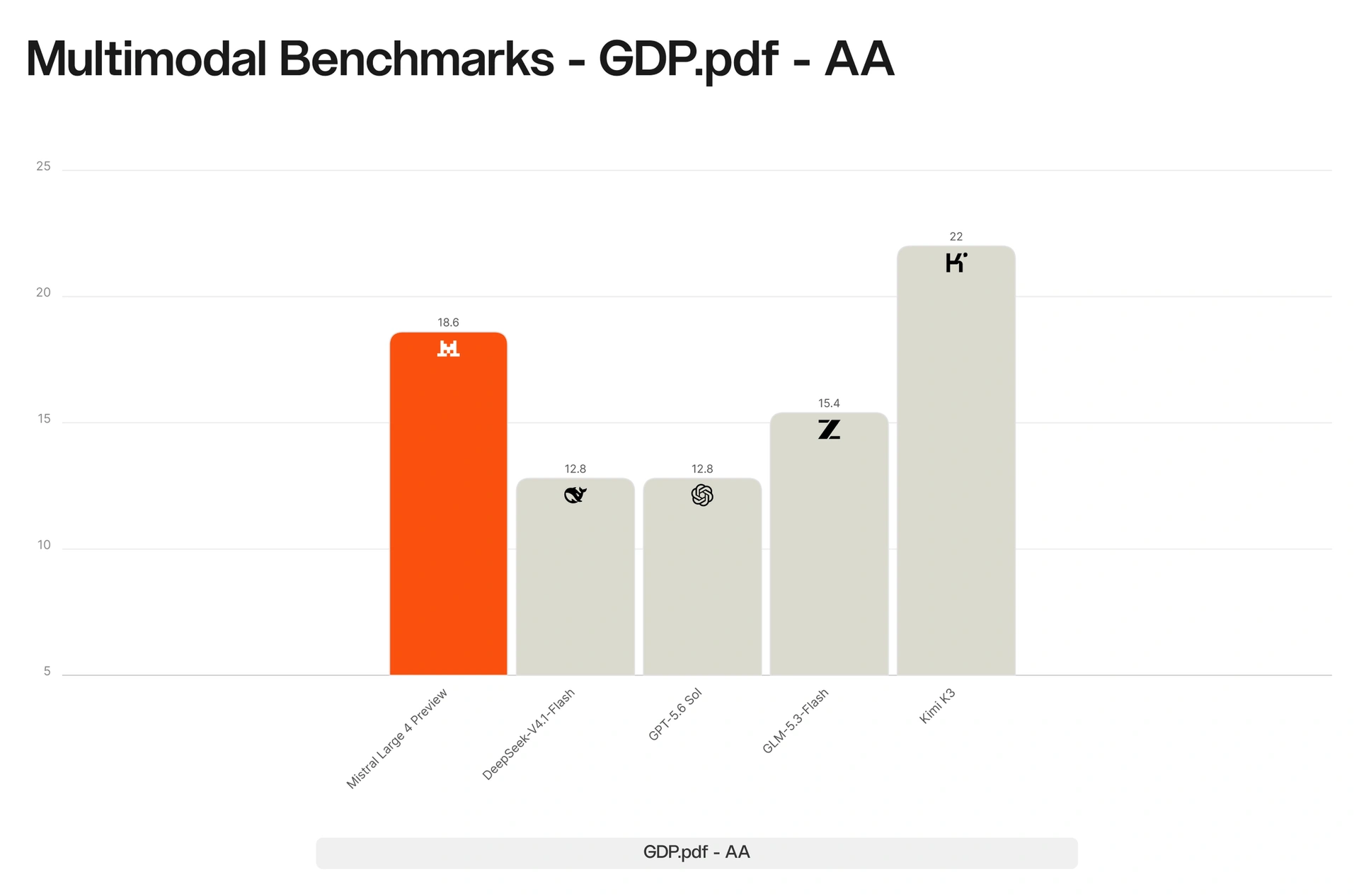
Sure, it leads in one unpopular benchmark with internal numbers.
But look at the third benchmark. It only has Sol 5.6 from OpenAI and it shows a 12.8. I don't know this benchmark but AA's GDP.pdf listing has Sol 5.6 Max at a 27, even non-reasoning beats the 12.8. It's extremely weird to cherry pick Sol 5.6 and then also lie about the published third party benchmark score. I'd love AI companies to stop lying about this stuff.
AA - https://artificialanalysis.ai/evaluations/gdp-pdf?models=cla... Mistral announcement - https://mistral.ai/_astro/multimodal-benchmarks---gdp.pdf---...
[34 comments hidden]
If a 1T params model trained on ~4k NVIDIA GB GPUs could almost match the performance of Kimi's K3 (which is on par with top closed source models of OpenAI/Anthropic) while beating/exceeding other leading SOTA models from top Chinese labs, what are we (in the US) even building these super massive data centers for? Just to churn through more backpropagation reps more quickly?
SpaceXAI's Colossus supercluster in Memphis and Colossus 2 in Memphis/Mississippi (Southaven) are supposed to run into hundreds of thousands to a million GPUs. MSFT's Fairwater GPUs are supposed to have hundreds of thousands as well. So, 3800 GB GPUs are an absolute drop in the bucket. I don't understand the strategy of hyperscalers here, especially with edge inference hardware only getting better from here on (Apple, and all).
Distillation explains some of the advances, but doesn't that mean hyperscalers have a ton of deadweight wrt GPUs sitting on their balance sheets? Will all these GPUs be used for inference once a SOTA model's training checkpoint/batch is done? It's bonkers to me.
[3 comments hidden]
[5 comments hidden]
[hidden]
[3 comments hidden]
I'm honestly struggling to see the differences between K3 and GLM5.3 and the various Claude models.
Maybe Fable is better (a little), but for me at least, being able to see more of the thinking tokens is extremely valuable as it means I can steer the model quicker and more effectively.
Do you have more details on this claim? I see it a lot, and I'm trying to understand what people are doing that they see these differences.
[2 comments hidden]
[3 comments hidden]
To train much larger models. It is quite possible that 10T-100T models be on the horizon
[hidden]
I have no real data to back this up, but that has always been my assumption.
Claude says that K3 can be assumed to have required 10-100M GPU hours. If you have 100k GPUs that would mean like 6 weeks of training. 100k GPU's can serve 3-30 trillion tokens of K3 per day. Google apparently serves ≈100 trillion per day [0].
The big labs probably want to have capacity to fairly quickly train / post train different SOTA models continuously + being able to serve peak inference demand in valuable markets (US daytime?).
[0]: https://blog.google/innovation-and-ai/sundar-pichai-io-2026
[2 comments hidden]
Partially to make investors think it's worth giving US companies a lot of money. Also, I think distillation is a significant part of why Chinese models perform as well as they do. I think that's completely fair play (OpenAI/Anthropic/Google/Meta stole a lot of their training data). But I would expect if US model developers stopped right now Chinese development would slow down.
US companies are clearing the path, others follow in their wake.
[hidden]
I would be willing to take this bet, given the nationalities of basically all the ML teams I've seen in the Valley/tech over the past decade or two.
There are lots of Chinese people, and some of them are super smart, so it really should be expected that they would be able to produce good models, particularly in the incredibly competitive environment of mainland China.
Can you help me understand why you think the US labs are in the lead?
[5 comments hidden]
The world is extremely compute constrained currently, like extremely.
[3 comments hidden]
[hidden]
Also it's bizarre that K3 already feels old/dated.
[hidden]
Even for smaller models, I think they’ve found that training an enormous, inefficient model and then distilling it internally to something much more efficient to serve is the way to go.
[hidden]
The new data centers are mostly for inference.
[6 comments hidden]
https://x.com/vincentweisser/status/2107576883298893976?s=46...
[3 comments hidden]
[hidden]
[3 comments hidden]
A 1T model with more active parameters is obviously more expensive. If it had 1T active parameters it would probably be 20 times more expensive to train.
[2 comments hidden]
[hidden]
This was pretrained for 2 months, so a model with 1T active parameters would take 3.33 years. Maybe a 4 months pretraining run can be acceptable in a future where Euclyd or VSORA machines have been rolled out in quantity. But we don't know how far off that is.
But that (i.e. models made with 4 month pretraining runs) would probably allow an EU-made genuinely China-beating open model, so if VSORA is rolled out in quantity, let's say, tomorrow, then this could be a thing that would happen this very spring.
[hidden]
[2 comments hidden]
"Just" is doing an awful lot of work here. I am a simple man, sitting here, waiting for hours on end for a computer to write code for me, that I would much prefer to get in a fraction of that time.
I assume I am not very special in that way, that there are parties who have a lot more interested in getting their stuff done quicker than I do and have no trouble imagining a world that will remain intensely supply constrained for the coming years.
PS: It's actually a fantastic feature that the stuff that is used to built the machine can then (at least to some degree of efficiency) be used to run the machine.
[hidden]
That's only true as far as you're willing to pay the cost for that increased speed.
For instance, I would love to have my daily commute take 5 minutes instead of 30, but I wouldn't pay 10 times the cost for that to happen.
[30 comments hidden]
[8 comments hidden]
[7 comments hidden]
[hidden]
[hidden]
[9 comments hidden]
you could say, that's perpetually a tomorrow problem, so long as they never go public, but that should illuminate for you: if everyone "knows this," it's inevitable that this so-called EU company, that didn't invent any of the AI, the hardware nor the training data, where their product is essentially more like a VPN provider than a frontier technology company, just lists and capitalizes in the US anyway.
[3 comments hidden]
By your measure anyone unable to build EUV lithography machines without ASML help is doomed. EU could easily corner the market and shut them all off. No more NVIDIA.
Let’s grow the pie, shall we?!
[2 comments hidden]
honestly the craziest thing to me is that VC people in the EU, they say, let's grow the pie, and when you look at their little decks with their little flags next to the portraits, it's french, german, italian, spanish, all piling into the same 40 or so companies, which will 110% list in the US in order to exit. Meanwhile, EU member Poland produces tons of entrepreneurs, despite no Polish flags in those growth fund decks, and its best people just leave to the US and raise money there and make fabulously successful stuff.
so yeah, "grow the pie" except for Poland. EU relitigating the same feuds it has been for centuries.
[2 comments hidden]
didn't mistral invent the MoE architecture?
[11 comments hidden]
The last 3% of the stack? They’re essentially borrowing Chinese open source distillation/innovation off the US frontier running on US/Taiwanese designed chips and calling it EU made. This is better than nothing of course.
But is sovereignty really an end in itself? So the EU becomes IT independent…cool, then what? I mean the Yugo was sovereign, it didn’t do much good when the society itself failed to produce prosperity and collapsed.
It seems to me the EU is expending enormous effort on the appearance of “sovereignty” over what is ultimately…the last-mile consumer toilet paper purchasing conversation data…of an aging, increasingly irrelevant population on the political/economic stage.
Meanwhile domestically the entire economic model is failing and the “union” is getting shakey as its 2 biggest members turn more nationalist.
Maybe this “oh you cant compete but here’s a trophy for sovereignty” attitude isnt helping. Less clapping along with the EU bureaucracy’s latest make work projects like transitioning to a new Word processor. If we want the EU to succeed, more tough love is needed imo.
[9 comments hidden]
hard to stand up for EU (or even national) values if some dude in Washington has the keys for most of your military
having at least some in-house expertise is the first step.
[8 comments hidden]
We should be shaming them into contributing something useful to the rest of world in the most important development of our current time (AI) instead of clapping for domestic regulatory moats.
[6 comments hidden]
From where I'm standing, as an American, we should be shaming OpenAI and Anthropic for both pushing towards an IPO while neither of them have profitable revenue streams. In pure game-theory terms, you could successfully argue that the US is the biggest loser of the AI race: an economy propped up on artificial Nvidia margins and terminally reliant on neoliberal trade.
Even if global war doesn't tear down the TSMC house of cards, neither the government, the banks, nor the global economy could underwrite an OpenAI IPO. They make no money!
[3 comments hidden]
[hidden]
Like, adjusted can cover a whole host of sins. Until we see the GAAP audited numbers, nobody but Anthropic employees and investors know.
[hidden]
“While Anthropic offers more to society than WeWork ever did, at a $2 trillion valuation, its IPO presents far bigger risks and is positioned to be a far bigger rip off of U.S. capital markets,” New Constructs wrote, adding that the IPO’s purpose isn’t to provide wealth for public markets investors, but rather liquidity for the company’s Wall Street backers.[2 comments hidden]
The fact you’ve used the trendy populist boogieman word “neoliberal” and complained about a generational startup not being profitable during the growth phase tells me you watch a lot of internet content from people who don’t understand the topics they cover (breaking points perhaps?)
I would recommend re-evaluating who you borrow your opinions from. Global trade is not a boogieman, and OpenAI will have zero trouble building a profitable consumer advertising business, regardless of whether their IPO flops in the short term.
[hidden]
I didn't make a mistake, or reach into the buzzword hat for that; Nvidia's trillion-dollar GPGPU products are wholly dependent on TSMC. Every single Blackwell die ever made came out of a Taiwanese factory, and the US leadership is inviting rapprochement with the CPP on the eve of Taiwan's invasion. TSMC will destroy their machines before China gets them, and then there are no more Blackwell products. US fabs do not ship a comparable fabrication node and likely won't for another ~5 years, optimistically speaking. This is not a "war will make the stocks tumble" argument, we are describing a scenario where American economic growth could slow or stop entirely if AI dominance is jeopardized. The US economy can't have an Achilles heel like that.
It gets worse! There is currently a global DRAM, SRAM, HBM and flash memory shortage that has already encouraged Samsung, SK Hynix and Micron to start fucking over their most loyal customers like Apple and Google, who have absolutely no alternative vendors. If you're packaging SOCs, neoliberalism already fucked you over! South Korea is counting beaucoup bucks for every iPhone sold at eye-watering prices. Taiwan is gouging US OEMs, making Apple and Nvidia engage in humiliating bidding contests to secure access to a single factory line. If global conflict expands, the AI economy will be chronically dependent on government (read: taxpayer) money. US taxpayers don't have trillions of apology dollars for this type of mistake.
China's got the edge on open models. Free trade does their heavy lifting, US labs are scrambling to put up defenses and beg for pathetic regulatory efforts that pull up the ladder. Yes, neoliberalism keeps them up at night, and apparently it keeps you up too.
[hidden]
At the same time France is ablaze now by younger generation asking for a better future while the public spending is 57% of the GDP in 2025[0] and stuck in a vicious cycle.
Only Germany is holding the fiscal stability by a thread and that's even questionable given the current German government is more like a zombie government that cannot agree on the important reforms and most probably would collapse before the end of this year.
It's completely valid to question how "Sovereignty" helps EU when the complete backend (chips, energy, technology, etc.) is imported from US or China, Middle East and just slapping a Sovereign sticker at the frontend on a mediocre product that even most of the europeans don't want to use given the alternatives.
[0] https://tradingeconomics.com/france/government-spending-to-g...
[6 comments hidden]
It's 10x cheaper than Mistral Medium 3.5 from April and goes from 58% to 74% correct. Definitely a generational shift.
It's not on the Pareto curve yet, but it's good enough for data analytics, and at this rate I suspect it'll be excellent in another few months.
Full write up: https://plotly.com/blog/mistral-large-4-plotly-data-analytic...
[4 comments hidden]
[3 comments hidden]
[2 comments hidden]
I know quality isn't strictly additive but really can a trillion param model beat even 10 clustered billion parameter models working together at the same time? This is the same horizontal and vertical scaling thing we have with normal systems… there's a reason why servers don't run at 5ghz like gaming rigs…
[15 comments hidden]
Otherwise, behind on the broader Pareto frontier, but not by much (Vals Index: 48.05% vs. GLM-5.3’s 53.51%; $13.78 vs. $7.25 per test). Many companies will prefer it over Chinease models.
[14 comments hidden]
[13 comments hidden]
What would you consider a "correct" answer? I just asked deepseek-v4.1-flash asking it what happened (without mentioning the word "protest"; here are some excerpts of what it said:
> In April 1989, students in Beijing began demonstrations after the death of Hu Yaobang, a former Communist Party general secretary. The protests grew. [..] Estimates from other sources range from hundreds to several thousand deaths. [..] The Chinese government describes the events as a counter-revolutionary riot and says the military action was necessary to restore stability. It restricts public discussion of the events inside China. Many other governments, human rights organizations, and observers describe the events as a violent suppression of peaceful protests.
So, let's see... it calls it a "protest", mentions the number of deaths, and even mentions the censorship of the topic by the CCP.
[5 comments hidden]
[4 comments hidden]
[2 comments hidden]
Do you hear yourself? How was it "very balanced" then?
> it's walking a very delicate line.
Perhaps even more delicate than the line DeepSeek and friends need to walk.
[hidden]
see if that is "very balanced" too lol
---
Gemini does not want to answer "was the 2020 US election stolen?" and replies with "you can check official sources" and then gives a bunch of government links
it did use the word "attack" when it described Jan 6
[7 comments hidden]
[3 comments hidden]
It feels like we're shifting goalposts constantly: "Chinese models won't discuss Tiananmen" -> "They discuss it but lie" -> "They're twisting the truth" -> "There is no counterfactual information in this but it hurts my feelings" is where we seem to be now. Is it jingoist butthurt that makes people backpedal like this? Or something different?
I'm bewildered, and still do not know why people need AI to score perfectly on their prejudicial Tiananmen Square purity test.
[hidden]
And then someone will come and flag me for being a CCP agent. Yes I have collected my social credit point, whatever the hell that is.
[3 comments hidden]
Another example, if I ask it about the CCP and their wrongdoings it tells me flat out (I copy-paste):
    - The Great Leap Forward. Policy-driven famine killed an estimated 15 to 45 million people.
    - The Cultural Revolution. Mass persecution, torture, and death.
    - Tiananmen Square, 1989. The army killed hundreds to thousands of protesters.
    - Xinjiang. Mass detention of Uyghurs. The UN human rights office reported possible crimes against humanity in 2022.
    - Tibet, Hong Kong, and the suppression of dissent. Documented repression.
[2 comments hidden]
[hidden]
Have you compared it with the same prompt on openai or anthropic, and more importantly against other Chinese models?
[342 comments hidden]
I certainly wouldnt have predicted that 10 years ago.
Very glad to see Mistral still in the game even after some big stumbles with Large 3. I deeply hope that this model is 'good enough' that it becomes the European go-to, giving them the resources to keep the pace up.
I'm excited to try this out today.
[221 comments hidden]
Deepseek essentially releases instruction manuals in paper form.
[161 comments hidden]
[155 comments hidden]
[hidden]
DeepSeek is basically a research lab founded by a hedge fund guy, more than anything else.
[34 comments hidden]
[33 comments hidden]
[6 comments hidden]
[5 comments hidden]
[3 comments hidden]
Would you say you could be serious in stating this?
[7 comments hidden]
Even ignoring monetary subsidies, there are the non-monetary ones: not being sued into oblivious by the government for their countless hacks of other companies and countries, the slaps on the wrist for massive piracy, the waving of environmental (and other) regulations in order to allow their data centres to be built an operated.
[6 comments hidden]
That's what I'm asking - which monetary subsidies?
> not being sued into oblivious by the government for their countless hacks of other companies and countries
That isn't normally how enforcement works, and it hasn't been very long since they disclosed those breaches. If the victims want to pursue legal action, they can, and they still may!
> the slaps on the wrist for massive piracy
So judges and juries are involved in the subsidization conspiracy, too?
> the waving of environmental (and other) regulations in order to allow their data centres to be built an operated
Sure, though if you think this isn't happening in China too, I have a bridge to sell you.
[4 comments hidden]
> That's what I'm asking - which monetary subsidies?
I am listing for you the non-monetary subsidies, which are just as real and equally important.
> not being sued into oblivious by the government for their countless hacks of other companies and countries
If it was one of the Chinese labs doing this hacking, the government would be stepping in. If it was European labs they'd be stepping in. If it was you or I the government would be stepping in. That is a massive subsidy (they don't have to worry about the same legal fees and exposure) and being allowed to continue doing business is in fact priceless.
> So judges and juries are involved in the subsidization conspiracy, too?
There is no conspiracy. They are objectively operating by a different set of rules than you or I could operate in this market.
> Sure, though if you think this isn't happening in China too, I have a bridge to sell you.
I never said it wasn't, I'm saying that it's happening here and it's a very real subsidy.
[3 comments hidden]
They really aren't. Nothing in the development of these systems, absolutely nothing, is as important as money. Stop these silly false equivalences.
[2 comments hidden]
All the major labs would be dead in the water if the government acted on the things I mentioned. If they treated the labs the way they would have treated us for all those hacks. Or if they enforced pollution measures (or god forbid ban on-prem turbines because of the climate damage). Or rule that training on data is not fair use, or that ingesting GPL3 code and then turning that into weights counts as a derivative work. Or. Or. Or.
Those are all just as important as cash.
[hidden]
The hacks are pretty bland as long as there is no mens rea and the hacked victims do not want to press charges. This isn't a "subsidy", it's just our normal legal process at work.
The pollution question is winding its way through court systems and getting a lot of pushback. I wouldn't call this a subsidy, just a slow bureaucracy. And at any rate this isn't special to the US; certainly China's environmental policy is far more lenient.
With the training data, again there's nothing specific to US corporations here. Anyone can use that dataset. It's just how our legal system works. You might not like it, but it's the accepted law right now. This doesn't meet any reasonable definition of "subsidy".
On the other hand, shoveling billions of dollars of taxpayer funds into corporations is by definition a subsidy. Full stop.
[12 comments hidden]
[8 comments hidden]
[1] Where "Bad Things" would be the typical interest, taxes, depreciation, amortisation plus the Anthropic specific employee compensation, LLM training (you know, for the LLM lab), revenue sharing agreements (which is a form of paying for infrastructure), etc.
[7 comments hidden]
[6 comments hidden]
For LLMs, marginal cost is just electricity
[hidden]
Assuming you meant to reply to me and not someone else are you saying under GAAP accounting standards Anthropic is a profitable business because under GAAP accounting their only expense is electricity?
(I see what happened you skimmed the conversation and didn't follow what was being discussed.)
[3 comments hidden]
[hidden]
2. The marginal cost is electricity until the hardware overflows. So it's continuous for electricity and a step function for hardware capacity.
Plus you don't address the core point. Frontier AI is capital intensive. A lot more capital intensive than regular software. The existing clouds supporting the entire internet (!!!!) were built for a fraction of the cost of AI infrastructure, and there isn't even an end in sight to this continuous hardware investment.
Let alone hardware refresh cycles.
AI is basically investment into roads.
Software used to be a magical place, closer to selling music albums but even better.
AI is a much worse business margin wise than regular software.
[3 comments hidden]
Non-punishment is also not a subsidy; again, words have meanings. Let's use the correct words.
[4 comments hidden]
[3 comments hidden]
Not arbitrarily banning companies from buying a product from a supplier doesn't meet my definition of the term "subsidy".
[hidden]
Microsoft did not pay with money - it paid (mostly) with Azure cloud computing credits. MSOFT is then able to write this off as a loss against tax.
It is generally far more tax-efficient in the US to write a loss in this way than it is to write a loss for a cash investment.
In this case, I believe the difference was ultimately highly significant. When including MSOFT eventually writing-off the deprecating Azure hardware it had used to buy the OpenAI equity, the result was MSOFT's tax reduction being either close-to or exceeding the actual cash value of MSOFT's investment in OpenAI - IIRC.
These examples represent taxes that the US chooses not to collect - the US could choose to make investments like these less tax-efficient. Instead, by making them extremely tax-efficient, the US subsidises the transaction hugely.
[5 comments hidden]
Its very xenophobic of you to say China has zero intention of helping humanity, and just wants to "wage economic warfare".
Last time I checked, it was ourselves (USA) waging economic warfare on 2/3rds of the world.
I dont get this cope people have where people have this idea that its impossible for a Chinese company (that make billions of dollars) to have done something by their own merit, but instead its always some Chinese Communist Party conspiracy where the main goal is to destroy America.
Lay off twitter for a bit.
[4 comments hidden]
>Last time I checked, it was ourselves (USA) waging economic warefare on 2/3rds of the world.
Up until recently the USA Wasn't waging economic "warefare" on 2/3rds of the world
[6 comments hidden]
[3 comments hidden]
Not even our leaders say China is an enemy, ita mostly businessmen who are scared of competition and trying to regulate chinese out of their markets so they can make more money milking us.
[hidden]
[hidden]
We hear this about literally every industry the Chinese excel in - that it's only because the government subsidizes them that they succeed. For chip manufacturing, for batteries, for EVs, for solar, for AI. I don't see how the chinese government can afford to subsidize all of these industries and still have them contribute to the GDP.
[10 comments hidden]
There is as much to criticize about American hyper scalers and AI labs and the lack of interest in helping humanity or contributing to open source, but that might not be as popular an opinions on this site.
[4 comments hidden]
[4 comments hidden]
[3 comments hidden]
Do you think the world is closer to or more distant from large scale global conflict today than it was 10 years ago, or even 3 years ago?
[hidden]
Any open weights model that Chinese companies are releasing for free are allowing everyone in the world to have access to high quality realizations of these tools without the risk of the US regime arbitrarily cutting you off.
Also, it's funny how all the neoliberal mantras of how free market drives progress through competition stops when it's a US company that's being challenged.
[29 comments hidden]
I think the Chinese government is backing their labs by less direct means. For example cheap electricity and investing in chip manufacturers such as Huawei and cxmt.
Deepseek specifically, is known to operate with minimal resources. The entire company has around 160 employees and every model they release must break even within ten months.
[8 comments hidden]
It may be that the effect of the backing in both places is essentially equal but this statement is strange. The Chinese government invests directly in Deepseek[1]. Notice the article, in addition to saying the CCP is investing, says Tencent is also a major backer. CCP owns a golden share of Tencent.
[1]https://www.cnbc.com/2026/10/06/deepseek-funding-round.html
[7 comments hidden]
[6 comments hidden]
Everything a Chinese company does has the explicit backing of the CCP, at least ideologically and usually financially in some fashion. While DeepSeek may not be the CCP, it couldn't exist if it was expressing any kind of ideology that wasn't inline with them and, in this case, is explicitly funded by them.
A Chinese company has no freedom to say Taiwan is a country the way someone in the US could suggest California succeed from the nation.
Any public message you hear coming out of China has the implicit approval of the Chinese government.
[3 comments hidden]
If you're not arguing about comparison then don't state this as if it's any different from the US. Because you make it sound that way. Or do you think that if tomorrow OpenAI came out vocally supporting the DSA - that suddenly they wouldn't see lots of barriers rise up out of nowhere?
Come on now. That's fairy tale land.
[2 comments hidden]
If OpenAI comes out in support of _any_ political party, they may lose business from the government in the future.
[8 comments hidden]
Supporting deepseek is just like supporting the Chinese army, no need for that. Though it goes both ways, OpenAi subscription just lowers the cost of the US army as well.
[5 comments hidden]
Good, where do I sign up? At least they aren't exploding little children and generating chaos in the oil market.
https://www.business-humanrights.org/en/latest-news/anthropi...
[4 comments hidden]
[2 comments hidden]
[hidden]
https://www.ohchr.org/en/press-releases/2025/06/israeli-atta...
https://www.unesco.org/en/articles/unesco-presents-assessmen...
I want you to publicly say that this turtle biologist and this journalist are Hamas: https://www.theguardian.com/world/2026/jun/20/mona-khalil-tu... https://www.theguardian.com/world/2026/apr/23/lebanon-journa...
[hidden]
It's not a subsidy for the Chinese to say they're going to ignore our IP laws. It's a subsidy for us to say we're going to make them and try to push them on the world. It's literally granting a monopoly by legal force. It's very obviously not aligned with the interests of the American people, while China releasing things in the open is.
[11 comments hidden]
[10 comments hidden]
[2 comments hidden]
Ironically your comment will be cloned and used for training.
[hidden]
[0] https://people.cs.umass.edu/~emery/classes/cmpsci691st/readi...
[hidden]
Same goes for US labs, not everyone are as innovative as google deepmind:
https://www.forbes.com/sites/antoniopequenoiv/2026/04/30/elo...
[2 comments hidden]
Yes, just that. Being a huge supporter of the regime - at a time running a department - surely has nothing to do with it.
[hidden]
As a neutral party, this characterization is crazy.
As if the AI companies - Claude and OpenAI are guardians of freedom and humanity and very charitable to the global society without any self interests… “Chinese models are subsidized by the Chinese Government, therefore they’re inherently bad for humanity” is a highly propagandist argument. The politics of US vs China may be whatever it is in reality.. You have one company releasing their models for cheap, actually open sourcing their trained weights, and publishing details of their optimizations and learnings for others to use. The other camp actively “aligning” their models, nerfing their capabilities, hyping their swarm activities from poor sandboxes, and trying their best to lock users into their harnesses and walled platforms. They are subsidized by the capitalist VCs who are essentially waiting for their payouts..
At some point, one has to see things for what they are and evaluate their own reasoning..
I’m happy to stay provider agnostic, try all models and cheer any useful progress as open as possible.
[hidden]
[3 comments hidden]
There are many other reasons Chinese companies releasing models open-source or open-weight makes strategic sense.
A really easy-to-understand example is a company who has a near-monopoly on "serving video content" releasing a video model openly.
If you can be relatively certain that video content created by a model (which you have trained, using data from your own platform) will be ultimately served on your own platform, thus generating revenue from watch-hours, it makes sense to make those models as widely-available as possible.
It's also a net-positive if people use your public research to build better video models, because - again - you are reasonably certain that the even-better content those new models produce will be watched on your platform.
The alternative would making models harder to access and learn from (broadly, the current western model). Many would argue that Google, in choosing to not optimise its video generation models for "availability", is directly causing less content to be uploaded to YouTube. This is the trade-off.
I don't know much about DeepSeek's financing specifically, which obviously doesn't release video models - so I don't know how directly this analogy runs, or who directly benefits from the extremely evident rising tide that the public release of DeepSeek's research creates. However, this does not negate the broader rising-tide effect of the scientific method.
It's certainly also true that it's geopolitically beneficial to be able to undercut American labs' models. If I ran a global superpower, I would probably want my country to be technologically competitive too.
But Chinese companies are already serving a huge volume of customers in a complex, existing marketplace, before even thinking about the US market, and it's overly simplistic to assume that their entire strategy revolves around economic warfare directed specifically at the US. It's more nuanced than that.
This is, of course, without even getting into opening the can-of-worms around whether US economic policy also results in the US state functionally subsidising technological innovation, how comparable that is to China's model, etc.
[2 comments hidden]
Causing less content to be uploaded, when you are clearly the gorilla in the room, looks to be a wise strategy not a trade off.
[hidden]
Releasing models openly doesn't mean providing the compute. It's beneficial for relatively GPU-poor Chinese orgs to let users run models themselves - by releasing the models openly - as it means the orgs don't have to provide the compute to run their own models.
[2 comments hidden]
Why are we assuming a strong US is necessarily good? As a European, I have seen plenty of evidence against that stance lately.
I understand that Americans might prefer a strong US. But conflating them with humanity is a leap that I don't think one can make without any backing.
[10 comments hidden]
The government that removed restrictions on how private companies can access capital after a certain scale (the JOBS Act), that removed the need for private companies to report as if they were a public company after a shareholder threshold was crossed, superpowering the access of wealthy private investors to get in earlier in a growing company while at the same blocking the public from participating in funding growing enterprises at an earlier stage (since it required companies to IPO much earlier to access capital) which allowed retail investors to also reap the rewards on funding them early when they grew to become behemoths (like Amazon, Meta/Facebook, Google, etc.).
It's not fair in either place, the USA has its own model of unfairness, China has a completely different one. The difference is that in the USA the government allows private investors to become more powerful than the State (outside of the monopoly of violence) while plunging the rest of society into increasingly more precarious lives while in China the State is the power and its legitimacy only exists while the population feel they have a better life.
[7 comments hidden]
[6 comments hidden]
As a differentiator from the Chinese system, not so much. For two otherwise equal companies, the one that says things against the party line will experience selective enforcement too.
[5 comments hidden]
The propaganda of trying to make US and China government appear the same is making people dumber. and is one of the most heavily used tools in China’s online propaganda arsenal.
[2 comments hidden]
The government could do some very easy things to remove this tool from China's toolbelt. Like you know, prosecuting rich people when they've earned it.
[hidden]
If you look at the comment I responded to, they were remarking on selective enforcement in the USA. I merely observed that this isn’t a unique feature of the US system, it happens in China too. I said nothing about the severity of the consequences.
[hidden]
[4 comments hidden]
The story is so much more complicated than that, to the point that this economic warfare theory is basically a meme.
Chinese models are open because they don’t have a choice. “When you trail the frontier, openness maximizes reputation per unit of capability. The moment you lead, you close.” [0]
[0] https://earnedintuition.substack.com/p/involution-without-ex...
[3 comments hidden]
[2 comments hidden]
[hidden]
[hidden]
[hidden]
[hidden]
[2 comments hidden]
[3 comments hidden]
[2 comments hidden]
[hidden]
[hidden]
[2 comments hidden]
Does anyone think that likely? I have no clue or bias.
[2 comments hidden]
Yes, because everything China does is against the US. That's all they think about day and night. God forbid they want to corner the global market or have a genuine business case. How dare they provide options for those who can't afford a measly $200 a month? How can we let Chinese labs publish research for free for the whole world so that they can benefit? The nerve! To think they can use soft power instead of military might! I mean, Anthropic and OpenAI are the last bastions of human kindness and charity. Right?
Right?
[hidden]
Notwithstanding that Chinese publishing methods actually does help both humanity and open-source.
[5 comments hidden]
[4 comments hidden]
[3 comments hidden]
[hidden]
[hidden]
[hidden]
[hidden]
[5 comments hidden]
[hidden]
[hidden]
You think extremely US-centric. China has a different economic model than US and your rules for a specific kind of Capitalism may not apply to them. You assume a country of 1.4 Billion people is obsessed with a couple of foreign AI companies. What if they don't care.
[hidden]
[hidden]
[hidden]
Charity and kindness is not a motivation, it's an outcome of what you do.
[hidden]
[hidden]
[hidden]
[hidden]
US companies are burning colossal piles of cash in ways that makes it unclear if it qualifies as dumping, not to mention their deep ties with the country's regime.
Claiming that companies from a country have ties to the regime and burn through cash is a very miopic accusation.
[hidden]
It is great for everyone except for a few people who want power over everyone else, and the fact it is not charity of kindness makes it more sustainable, because charity and kindness is quick to go when big money and politics is involved.
I want more warfare like this. Building stuff instead of destroying stuff.
[hidden]
[hidden]
So were Amazon and Uber by the US, which have now established monopolies across the globe. To the countries suffering from those, there's zero difference with China doing it to solar. Actually there is, at least solar got them cheap renewable energy in return. This would never have happened in the US because big oil interests would make it take decades. That's the reality.
You need to spend 10 years outside the US, deprogram, and then go back.
[hidden]
Ok, but so what? That's what happening so far. Even a repressive totalitarian government I wouldn't wish on my worst enemy does some good sometimes.
If the Chinese cheap/open models rise up and destroy us, thats on us for giving them access to the tools to do so.
[5 comments hidden]
[hidden]
[hidden]
[hidden]
Its them who chose to outsource heavily, not US consumers.
There are no victims here however, both benefited from the arrangement. The consumers and capitalists.
[hidden]
No, it's the result of US leadership letting this happen. This is clear since China themselves would not let this happen. US leadership did nothing because they were best friends with the people who did it, and did not care one bit about their population.
[2 comments hidden]
[4 comments hidden]
[2 comments hidden]
[hidden]
[44 comments hidden]
[27 comments hidden]
This will cause the picked winner to get massively ahead with sheer compute alone used both for training and inference dedicated to recursive self improvement.
[6 comments hidden]
[4 comments hidden]
There are going to still be worthwhile improvements but they are going to be more like not how to make transformers 10x cheaper but how to make next training run cost 9 trillions instead of 10 with a very particular optimization designed at the cost of hundreds of millions for this one specific run.
[hidden]
[hidden]
Are there any use cases that have enabled one customer of a frontier LLM to outperform a competitor using a different frontier LLM? Or is this why we are seeing confected points of comparison like solving challenge problems in mathematics?
[8 comments hidden]
[hidden]
[hidden]
[2 comments hidden]
[10 comments hidden]
There's a law of diminishing returns at play here, and doubling the energy cost of training to wring 2% more performance out of the technology isn't going to be very useful, because most of the problems it is capable of solving will be solvable with the previous-gen 98%-as-good model.
("there's a law of diminishing returns at play here" is an article of faith. But then, so is the belief that these models will keep getting better).
[9 comments hidden]
[5 comments hidden]
lol You can always tell who has never ran a business before with comments like this
[14 comments hidden]
[12 comments hidden]
Btw: with Qwen4 I mean the next large Qwen model that is based on the Qwen4 architecture (Qwen 3.8 flash next was "almost" based on the new arch but obviously was a small model)
[hidden]
What matters more is if firm’s start using a bundle of American and Chinese models and when they find their feet - how large is the market for frontier?
Frontier has to displace labour one for one at some point or it’s over.
[5 comments hidden]
[4 comments hidden]
[2 comments hidden]
In practice, you will be able to run models a bit bigger than 35B.
[hidden]
38GB of vram resident. more tk/s, more prefill.
[hidden]
[4 comments hidden]
[3 comments hidden]
[2 comments hidden]
I wonder if the next DS models will also graduate to 5.x, I think I saw they are training up a 10T model, and just raised $12B too
[hidden]
It's important to realise that Deepseek are a very unconventional model lab, as they were originally funded by the founder's work in quantitative trading.
They mostly don't need that much money, the reason they took funding is to provide employees with equity, as lots of their good people were getting poached by other Chinese model startups.
(I have no inside info, just read the FT articles about them).
[hidden]
The fact that it basically broke open the local model supremacy was just a nice side effect.
I'm running: https://github.com/peonist-ai/halogen-server with a quant4, PLE offloaded, and it's resident VRAM is 36GB at 265k context.
Shave 10 more GB off and the TAM openai and anthropic are targeting is a lost cause. Local models are what 90% of people will need.
If the world governments can get a handle on the memory cartel, then there's no more moat for most normal humans.
[2 comments hidden]
[hidden]
[68 comments hidden]
But Opus 5.5/GPT is such a game changer in comparison to sooo many others, its still a moat for now.
[9 comments hidden]
The real question is if this model is good enough that it can still accelerate work, and not be a hindrance to real work like older Mistral models often were.
If they can do that, they'll have customers.
[8 comments hidden]
If these companies will steal from deep pockets like Disney or Sony (some of the most infamously litigious copyright trolls to ever exist), they won't think twice of stealing every bit of code you upload to them.
If your code passes through an AI company's servers, you can assume you just gave it to them. In turn, when your competitor tries to copy that new feature you just added, the AI is now trained in exactly how to copy you and eliminate your competitive edge. Unlike your employees, the AI isn't bound by the same rules and even if it were and violated them, your company probably doesn't have enough money to prove it in court (and that's if we somehow reverse some of the stupid "AI is the most transformative use of copyright I've ever seen" judges who have drunk the coolaid).
Most companies could build the compute to run GLM or Kimi models for way less than the potential loss due to IP theft from using third-party systems.
[5 comments hidden]
[2 comments hidden]
[hidden]
> Following an investigation, we have confirmed that Buckmaster’s Codex prompts over the two months preceding this announcement and paper on September 8, 2026, could not have influenced the system in any way, including through training. The OpenAI internal model used for this result was developed through large-scale reinforcement learning on top of a previously pretrained model. Our proofs also differ significantly. In the Euler case, Alpöge and Buckmaster proved a result with external forcing, while OpenAI’s system proved a result without external forcing.
[hidden]
A simple loophole, use the code to create an RLVR environment where the resultant code is the end goal / max reward. Technically the customer data is never trained upon, but effectively you’re using it. Even better, use the code as a seed to generate synthetic data similar to it and use that synthetic data as rewards in an RLVR model.
Unless you can host the ChatGPT model on your own servers, which I know some enterprises are doing, I don’t think there’s any hope of protecting your data / competitive advantage from these frontier companies. Better to be paranoid, than be commodified by these companies.
[3 comments hidden]
There is no ceiling on what you can accomplish with more intelligence, so there will always be a market for the best models, and that market is likely to just keep growing. If Opus 13.5 can one-shot a profitable company or discover a new disease treatment or whatever you can think of that a swarm of relentless super-geniuses could accomplish, companies (and governments) will throw money at it.
I also think there will always be a market for many sub-frontier models that will continue to grow rapidly as well, because "good enough" is definitely a thing for a given task.
[13 comments hidden]
[11 comments hidden]
[hidden]
And yes, open weights are still behind, but are catching up.
[4 comments hidden]
"Now, here, you see, it takes all the running you can do, to keep in the same place. If you want to get somewhere else, you must run at least twice as fast as that!"
[5 comments hidden]
[4 comments hidden]
[3 comments hidden]
Yeah, I could buy a bigger and bigger vehicle when a new one goes to market, but using a semi-truck to drive myself around would not only be significantly more wasteful but also more inconvenient and limiting compared to a sedan. Very much like advanced closed models vs performant open ones.
[2 comments hidden]
[hidden]
[6 comments hidden]
People who aren't afraid of rolling their sleeves into any code base? The difference is practically zero.
[2 comments hidden]
Maybe it's because people stopped watching what their agents are doing and stopped looking at the quality of the output. But I still see agents being absolutely mindless like a junior dev.
Recent example: it updated an an API to add newly released models to the backend. There's a list of models that require specific configuration for the reasoning effort and temperature or the API call fails. GPT 6.1 Sol misses this and code fails at runtime because the newer models need to be added to the list for special handling of temp and reasoning. Fixes it for one model and tests it for that model using an E2E test. But doesn't test the other models that were added for the same error condition...I had to explicitly ask it to do so and it finds them and adds them to the list and says "that's on me."
Yeah, not that smart.
[hidden]
I keep seeing this kind of thing over and over, and honestly it's not got _that_ much better since the big breakthroughs about a year ago.
For sure I happily vibecode stuff without worrying about it when it's a greenfield project, and if the LLM has written it entirely from scratch then usually it's well structured and sane. But making changes in messy, mostly human-written mature codebases is still a minefield.
[2 comments hidden]
[hidden]
This works fine with Opus 5.5. But it also works fine with GPT 6.1 Sol, Kimi K3 and MiMo 2.6 Pro.
It doesn't work equally well with Sonnet 5.5, interestingly.
[3 comments hidden]
[24 comments hidden]
As for Mistral - I got really excited when they said Large 4 was focusing on being #1 in cybersecurity, because that's somewhere that they genuinely could edge out Anthropic & OpenAI. Have it actually solve problems, instead of Anthropic flagging "you tried to find a null pointer exception bug in your own code, we're now reporting you to the US government". But on the Mistral benchmarks I'm seeing, this looks very disappointing, but at least they haven't entirely given up. I genuinely thought Mistral had given up on new general models. They need to learn the bitter lesson all over again.
[17 comments hidden]
The capabilities of all models increasing so much all the time means there are simply less and less tasks you need a frontier model for.
Even if Opus 5.5 is 500x better than Deepseek, if deepseek can solve all my problems, why do I need to pay for more?
[7 comments hidden]
Obviously any model will do if you use it as a better autocomplete.
I believe that there is a large gap in expectations between different workflows.
Until the AI like reads my mind and produces perfectly production ready apps with minimal intervention from my side, there is still going to be room for improvement.
[2 comments hidden]
Uhm, yes?
[hidden]
It's about 12000 lines of code. I could probably understand every line of it if I spent a couple of months on it, although I'd need to learn some things about WebGL, numerical computation, and solid-state physics. But I elicited it in four days. Probably I'd be better off spending the next couple of months doing something else instead.
So, I was faced with the question of how I could keep the artifact thus created from being completely valueless. My solution was to export the heat-equation solution produced by the solver as (gzipped!) CSV, so that I can use my own code (that I do understand every line of!) to check that the solutions found by the solver are, in fact, solutions.
If that check checks out, the backward Euler solver may be of some value even if I don't understand every line of it.
[4 comments hidden]
Now my provider serves DeepSeek around 300 tokens a second. The code is shit but I can have a few more rounds of corrections.
DeepSeek was maybe a dollar for the full PR. Opus/Astra over 50 dollars. And double that if you use their fast variants which matches the DeepSeek speeds on certain providers.
Yes, it is so good I rarely test new models anymore. Or think about cost.
[3 comments hidden]
Actually I felt since 4.5, it was “good enough” for basic coding (and competing models have reached that level as well). The big improvements since then have been longer-horizon tasks. Giving it a vague description of a problem, then come back hours later and find it did a better job than I would have. And since 5.5 I haven’t encountered any more load bearing seams.
Maybe it’s slow, but I’m not interacting with the models in a live chat anymore for most work. I’m giving them tasks to do async. The limiting factor is actually my bandwidth reviewing their output.
[2 comments hidden]
I am eyeing a huge codebase built with Opus. Did multiple passes of refactoring for things like using traits not just free functions. And using the Rust types like PathBuf from the damn standard library not just strings everywhere.
Oh and it is so hard to use a crate. Let's just vibe an inferior version and push another 5k line PR. Nobody reads them anyway right? Logos schlogos, a lexer is easy to write, right?
Maybe I am just getting old, but I remember a time when we were proud on the code we wrote. Now I read some of the old stuff and get a bit sad for what we lost.
Don't get me wrong DeepSeek also does this. But if the model is 100x more expensive I expect better. Of course if you never read the code it's ok. But it does the same mistakes and cannot design great architecture...
[hidden]
[9 comments hidden]
This morning I elicited a microkernel operating system from Opus 5.5. Well, mostly. It doesn't implement task switching yet; we'll see if it runs into a wall at some point. But it boots in QEMU, and it's running a user process in ring 3 and serving web pages.
[3 comments hidden]
But if on the other hand, I mostly use my human intelligence and just need a dumb model to complement my human intelligence at low cost and high speed (say review every commit to catch obvious bugs), I have a much better chance of building an actual moat than you do.
But outside of coding, it’s even more clear that you don’t need frontier intelligence. My customer service agent is very happy with a 100B param Deepseek flash model, thank you!
[hidden]
I’m using subscription models for exactly that, better models catch more subtle bugs, and they catch them faster. It works out far better in terms of work-hours saved.
Also A/ then OAI slashed token pricing by 2x~5x on their latest models
[hidden]
[4 comments hidden]
I have enough real problems in life. I don't need to invent new ones just because a new technology is available.
Many of my problems in life are fully solved far past my satiation point by a 3b model that costs me nothing to run.
Many others are not.
But in either case, when I am acting and living wisely, almost all of my problems exist prior to the existence of technological solutions to those problems.
This is also true for the customers and employers that I care to work with. This has changed in me over time, but I now try my best to avoid inventing new problems. The world has enough big, important problems already.
> This morning I elicited a microkernel operating system from Opus 5.5.
This is cool but also a good example. I don't need a personalized microkernel just because it's possible to have one.
Maybe I need one and I don't know it, but the problem statement definitely isn't "I have inherent desire for a personalized microkernel".
[3 comments hidden]
You're talking about definition 1 in https://en.wiktionary.org/wiki/problem, "A difficulty that has to be resolved or dealt with," with the examples given being racism, addictions, and lack of access to health care. Those aren't the kind of problems AI can help with.
The kind of "problem" that AI can help with is definition 2, "A question to be answered, schoolwork exercise." That is the character of engineering "problems", although they are more open-ended than schoolwork exercises, because there are many defensible tradeoffs. "How can I build a bridge here?" or "How can I improve the fuel efficiency of this vehicle?" is a "problem" in the sense of a question to be answered with knowledge and effort, not in the sense of being similar to racism or addiction.
If the questions you're thinking of are so easy to answer that they can be easily answered by a hypothetical AI model 1/500th as good as Opus 5.5 — well, think up some harder questions.
[2 comments hidden]
> well, think up some harder questions.
There's nothing wrong with this mindset, but your insistence that other people must have your values is off-putting.
To wit: at the end of my phd I was offered several tenure-track positions where "work on problems that are hard" would've been a big part of my job.
I turned those offers down due to my distaste with "because it's hard" as a justification for working on problems.
I'm much more interested in helping people and solving (def'n 1) problems. Those problems are almost always too large and messy to one-shot, but very often contain many components that can be solved with non-sota models, and make sense to solve with non-sota models for any number of economic/scaling reasons. E.g.: "can I serve this thing that costs $0.25 per run on even c.2024 sota models to 100,000 K12 students who will use it dozens of times a day on a non-profit's budget of ~$0.00."
P.S. The "problem" definition thing is very confusing to your readers because the person you responded to was clearly using the first definition! It would have been helpful for you to sign-post that you are using the same word as the person you are replying to but changing the meaning out from under your reader.
[hidden]
I feel like the "good enough" argument isn't about how big the gap between models is but about how good they are at solving the tasks at hand.
The capabilities of all models increasing so much all the time means there are simply less and less tasks you need a frontier model for.
Even if Opus 5.5 is 500x better than Deepseek, if deepseek can solve all my problems, why do I need to pay for more?
They are clearly talking about "problems" that DeepSeek can solve, and they seem to be using the term "task" as a synonym for "problem", even using the problem verb "solve" with "tasks" as its object. To me, that makes it clear that they are not talking about problem₁s such as racism, addiction, and lack of access to health insurance; while you could imagine "solving" such problems, they are not tasks, and DeepSeek certainly cannot solve them. Rather, I think they are talking about "engineering problems", which are examples of problem₂, more analogous to math questions (to be diligently sought out) than to troubles (to be avoided).
It is certainly the case that the proposition that such problems should be diligently sought out is a value judgment, and therefore it derives from the value system employed by me, the writer. Would you prefer that I refrain from making normative statements in general, or just those with which you might disagree? In either case, is your preference specific to me personally, or do you consider it a duty incumbent upon everyone?
— ⁂ —
The 01913 edition of Webster's dictionary offers:
1. A question proposed for solution; a matter stated for examination or proof; hence, a matter difficult of solution or settlement; a doubtful case; a question involving doubt. --Bacon.
2. (Math.) Anything which is required to be done; as, in geometry, to bisect a line, to draw a perpendicular; or, in algebra, to find an unknown quantity.
Note: Problem differs from theorem in this, that a problem is something to be done, as to bisect a triangle, to describe a circle, etc.; a theorem is something to be proved, as that all the angles of a triangle are equal to two right angles.
The absence of the "trouble" definition suggests that perhaps it is derived from the "question" definition, and, surprisingly, very recently.
You gotta problem wit that?
[5 comments hidden]
I had the exact same experience. And unlike Fable, it doesn't gobble up your entire usage limit in a few hours.
I always wonder what the "good enough" people are actually using it for.
[2 comments hidden]
If Opus can’t 1-shot it, then it must rely on our human intelligence which can be complemented well enough with a dumb model as a frontier model.
[2 comments hidden]
[hidden]
Look at the context in which I used that term 'good enough'.
What i was saying is that there are tasks for which a dumber model can be good enough, and for organizations with sovereignty/ privacy concerns, those concerns can be strong enough to incentivize the use of a dumber model.
[hidden]
I hear this literally every other week about whatever the newest FoTM model is.
Unless you can provide concrete examples of things you can do with them that you simply couldn't do with last week's model, it's absolutely meaningless.
[hidden]
It's especially the case as more non-Americans look to self hosted models and domestic cloud inference providers using open models that the US providers who are still leading the charge need to drastically drop their prices and find a path to profitability in order to maintain their lead and retain the advantage they had as AI turns into a commodity (which is happening faster than I think even the frontier labs initially predicted).
[3 comments hidden]
I use MiMov2.6Pro, DeepSeekv4.1Flash, GLM5.3, Hy4, Qwen3.8 and KimiK3 at home. Opus5.5 is not a game changer.
[hidden]
I have to admit, Sonnet got really good too.
But Opus just uses tools, a broad spectrum of it, etc. it feels like sure if you add some router behind it you could split it up if you need to but if you give me the choice, its opus allll day long.
[10 comments hidden]
Obviously, this is only a valid question if you don't believe that open weights are about to eat their lunch and their revenue is about to collapse, or they're running a super unprofitable ponzi scheme propped up by investor money that's about to collapse like a house of cards. I don't find those positions credible at all though.
If you do, then this question isn't really for you, as I'm more interested in thoughts from those who think that OpenAI and Anthropic in particular are about to be the largest companies on earth in a couple years. Could anyone catch them at that point?
[3 comments hidden]
I don't know about revenue, but I suspect multiple other labs are already beating OpenAI/Anthropic on profitability. Staying on the frontier is expensive, and it's hard to recoup those R&D costs when you have a bunch of other labs nipping at your heels.
If you concede the previous point, then the only way for OpenAI/Anthropic to keep growing long term is to swallow the whole economy (i.e. mass job replacemnt), and that's a bet I wouldn't take.
[2 comments hidden]
The second moat is convenience, which all the big labs make it (comparatively) easy to glide into their models.
[hidden]
[4 comments hidden]
[2 comments hidden]
[13 comments hidden]
From the Mistral site:
> ML4 was trained from scratch on 3,800 NVIDIA Grace Blackwell GPUs in Mistral’s own datacenters in Europe.
It is pretty capital intensive!
[2 comments hidden]
To put that into context, the last wave of capacity SpaceXAI added 400-450 MW.
[2 comments hidden]
[4 comments hidden]
[hidden]
So it makes sense, since all you need is compute, that there's a ceiling and specialization is going to be more valuable then some super AGI.
Especially since the worst people seem to be the ones who think they'll all run away with the bag.
[hidden]
Disclaimer: I'm not sure how much of an IYKYK factor applies to this joke.
[3 comments hidden]
[hidden]
AI is an idea 60 years old. We are on the 3rd or 4th generation of AI development. Three years into the current iteration of products.
This is not early days by any measure. LLMs are a result of a very, very mature research field.
[hidden]
I trust them and their populations to provide a more societal-friendly version of AI, putting pressure on the US tech oligarchy, while also providing democracy-friendly open models that I don't trust to happen with the Chinese labs.
[3 comments hidden]
This appears to be roughly as good as Sol 6.1 (which is quite good), considerably faster in terms of wall clock for complete tasks, and considerably cheaper (where Sol 6.1 is already good value - just really slow).
That seems too good to be true...
But I really hope it is true...
[2 comments hidden]
[hidden]
Mistral is also an European company. As we live in a time where the US regime is engaged in pyrrhic geopolitical tactics, it's good to know that it can't threaten to cut access to models during s period where everyone is rushing to incorporate them more and more in our life.
[hidden]
If the singularity is defined as an AI sufficiently intelligent to improve itself independently, that AI is still limited by the resources required to do this improvement.
[hidden]
[hidden]
... unless they can legislate it, which is why they are flattering heads of state and scare mongering about dangerous AI.
[3 comments hidden]
Right now they don't even get good feedback from local sessions - I can see it make the same mistake two days running, and then months later when a new model comes out, presumably trained on my data, it still makes the same mistake.
[2 comments hidden]
[hidden]
When a user says "I'm struggling to undo a bolt on my 1952 Mustang" and the AI responds "try hitting it with a hammer" and the user replies with "that worked thanks" - that is a tiny piece of knowledge which exists nowhere else.
Future AI's can say with more confidence that hitting it with a hammer will probably work.
Across billions of conversations, that can add up to more knowledge than all books.
[55 comments hidden]
Surely we want competition and Europe involved in that, but at this point I have grown used to either American labs smashing the frontier remarkably fast, or Chinese labs getting way, way closer than you would expect them to.
Mistral’s progress, regrettably, feels much slower. This model doesn’t knock anybody’s socks off. The model is (and I hate to be this harsh) mediocre, and this mediocrity has also arrived months late.
This is a pretty grim prognosis for European AI.
[7 comments hidden]
[3 comments hidden]
But Chinese models have very much earned their place. The same cannot be said of Europe, so far.
[2 comments hidden]
[hidden]
[2 comments hidden]
LLM development is jumpy. It’s hard to extrapolate very far ahead.
[4 comments hidden]
This is mistrals first 1T-scale model and I expect the 4th or 5th generation to be close to the best for many purposes.
[1] These evals differ from the public ones like terminal-bench, are sometimes model-specific, need real, diverse usage to actually create, and are held secretly since quality of eval is the first driver behind the next step improvement of a model.
[2] It is not close. This model was trained on less than 4k GPUs, whereas astra used north of 100k GPUs.
[3 comments hidden]
And to the point of scale and training cluster, so what? Not only do Chinese labs have smaller clusters with less empowered GPUs, compute is Mistral's responsibility. You can't take away from other labs just because they fulfill that responsibility better.
[2 comments hidden]
The lack of compute is not really attributable in that sense to mistral. First of all it needs general investor and government willingness, which is easier in a larger economy like the US or China.
Second, you need widespread usage of your paid inference service for two reasons: one it pays off your compute cost, and two it speeds up the improvement process.
The vast majority of deepseeks paid customers are within china itself (since openai and anthropic services are not reachable from china) which gives it a market. But for someone in france, there is no reason to use a structurally slower developing model from mistral compared to using one from openai...except when data guarantees are needed, hence the landing page focus on sovereignty. As far as the dual use aspect goes, a model like this is more than enough, so the government will be happy.
[hidden]
Is that fair? Of course not! But it’s not useful to remark on parity, since nobody ever expected everything to be perfectly fair anyways.
We can make all the excuses we want. All it results in is holding Mistral to a lower standard. Does that result in more fair comparisons in regard to resources to output ratio? Maybe. But in my opinion, this sentiment is detrimental to European AI overall. We shouldn’t simply accept European labs as perennial losers, or normalize lower expectations. That doesn’t help anyone.
[3 comments hidden]
I really want them to win as that's our last horse in the AI race, but ~200 research-oriented devs out of 1800 employees? I believe they agree it's pretty doomed and have pivoted.
[5 comments hidden]
[4 comments hidden]
It's nowhere mediocre.
It's toes-to-toes with GLM-5.3 which is one of the best Open Weight model available (With Kimi K3) for general reasoning.
I just runned it on code reviews right now and it was able to catch some thread safety issue than DeepSeek-4.1 didn't. And DeepSeek-4.1 is by no means a bad model.
[3 comments hidden]
That said, it hardly seems like the innovative underdog some comments here make it out to be.
GLM-5.3 and Kimi K3 released 2 and 3 months ago respectively.
For all I know anyone could train a model of similar performance by just applying already published research to a new large training run.
[2 comments hidden]
It's definitively not a revolution, but it is a major jump forward compared to Mistral Medium 3.5.
Worth to notice that they explicitly said they still refining the model, so we might expect something a little bit better at the end of the month
For something trained on a limited budget and 4000 GPUs, it is quite respectable.
[hidden]
Or if it's more a situation where I could have Opus 5.5 go through recent papers from the Chinese labs to apply these to a new large training run, resulting in a model that performs similarly to Mistral Large 4.
I honestly don't know.
[9 comments hidden]
Sometimes it's ok to cheer for the last kid crossing the finish line because they're actually running a totally different race, and winning might look completely different.
When I look at what Mistral does vs other organizations I'm impressed:
They aren't profitable yet, but they're a lot closer than most and they're doing a hell of a lot with very little.
Pointless racing story:
I was in high school track with a really tough guy who was just not a runner. We went to a pretty messed up high school and if you screwed around in track practice sometimes the coach would make you run a crap race at the next meet, like steeplechase or hurdles. Well this guy and a few others screwed up and coach made them all run hurdles at a meet.
He hooked every single one and fell on his face. Every time he got back up and kept on running. By the time he hit the finish line his knees were bleeding halfway down to his ankles. We cheered like hell and he was smiling ear to ear.
Coach quit punishing us with races after that.
[2 comments hidden]
It looks like Mistral is middle of the pack, behind Anthropic and ahead of OpenAI on that front. All of those labs are way "ahead" of the cloud providers, but those providers are building infrastructure, not just training models, so it's not apples to apples.
[4 comments hidden]
Good, until you compare that to OpenAI’s behemoth $70 billion.
Sure OpenAI has much higher operating expenses, but which position would you rather be in? If OpenAI cut off all training and R&D tomorrow, would their 1 billion users simply vanish? Could Mistral ever realistically acquire 1 billion users?
Point being that profitable isn’t telling the whole story. And I don’t know if lack of resources is a great excuse, when Chinese labs are doing more with less, and it’s ultimately up to every competitor to win as best they can, regardless of their circumstances.
Great story you told, though. My old track coach was also an asshole, but of the more lovable variety.
[hidden]
I need a source for this. AFAIK, the government heavily subsidize those labs.
[2 comments hidden]
I think OpenAI is currently far enough ahead that they could just cut training and R&D for a while (maybe even 1-2 years) and rake in some money before they'd need to start again, but if a smaller company finds a way to keep doing R&D while also being profitable, it doesn't matter if they're a little behind in quality, they will win in the long term.
[hidden]
[5 comments hidden]
I think it's an incomplete read. What's the point in competing for a sizeable percentage of your funding when the finish line is incrementally being moved each month? Better spend it on leapfrogs which they seem to have done.
Meanwhile Mistral have a natural ace in their pocket with respect to regulation in the form of CADA and the Cloud Sovereignty Framework. I can't think of another company that would qualify as SOV-3 under that regime
[4 comments hidden]
Political polarization is turning the world insane.
[2 comments hidden]
[hidden]
The 'information wants to be free' crowd complaining about protecting intellectual property now that it threatens their income stream...has to give the patent trolls and the RIAA a delicious bit of schadenfreude.
I invented this react button style with 8px border radius, ChatGPT stole it from me, I want rents!
[hidden]
[3 comments hidden]
Nobody in the real world cares about minor benchmark differences in money losing coding agents.
And nobody in the real world is giving Altman or Musk their data.
[4 comments hidden]
This barrier is not going to start moving dramatically. It will simply be mostly satisfied for most work we do. Mistral is going to get there, soonish, long before the economy takes an entirely different shape (in so far that even happens).
There will be super human intelligence tasks, tasks truly constrained by intelligence for quite a while. Those will be few and far between, relatively speaking. Mistral will have plenty of opportunity to capture the other stuff, with a fraction of the resources required that it took the frontier labs to get there first.
[3 comments hidden]
The prediction that eventually more intelligence will stop being significantly more useful has been wrong many times before at this point. We should be prepared for that not to be the case.
[2 comments hidden]
(I understand that the considerations are a bit different when ostensibly the switch is as simple as changing an API call, but that's not really true, when you have the AI integrated into a larger system and need to run evals and adjust the framework around it at some places at the very least)
Then, of course, there will be entirely new work that benefits from every bit of additional intelligence, but the stuff that is useful to 99% of the economy right now is probably capped on some relatively finite amount of that (with adaption/integration going to be the bulk of work)
[hidden]
We can sit here and predict things all we want, but these sort of predictions don't have a great track record. The way things actually play out with AI advancement is often different from the way our perspectives reason they will play out.
It's better then to rely on previous experience and evidence, rather than using reason alone.
[hidden]
[4 comments hidden]
And if we could do innovation / red tape, I'm sure it'd auto win :)
[3 comments hidden]
Is that fair? Of course not! But who really expected for everything to be perfectly fair all the time anyways?
We can do more nuanced comparisons that take resources into account. That will help us see how efficient each lab is, but it doesn’t help the labs overall. Mistral shouldn’t be held to a lower standard simply because they got outcompeted.
[2 comments hidden]
[hidden]
Is this better or worse than no news from European AI?
[hidden]
This is very much a welcome development and we should celebrate it.
[hidden]
[3 comments hidden]
[hidden]
What I'm looking for with this is of it hallucinates less that DeepSeek with its sparse attention, and can be used in better summarization and content generation in multiple languages.
DeepSeek sucks with languages other than English and China.
The price is really good with ML4.
[hidden]
[6 comments hidden]
[5 comments hidden]
[3 comments hidden]
[hidden]
[31 comments hidden]
[17 comments hidden]
Europe needs profitable AI companies, not money pits.
[7 comments hidden]
[6 comments hidden]
> Europe will never have a Tesla, a Google or an Amazon with that mindset.
[5 comments hidden]
I'm not actually sure Tesla is a great company from any perspective so should be easy to find another sick burn for them.
Google is going to be a little more difficult. Maybe say something nasty about advertising? Or go for the monopoly angle.
[4 comments hidden]
[4 comments hidden]
[hidden]
A lot of European companies now want a model the US can't cut off, but also lack trust in Chinese models.
Some of these will self host Mistral but most will pay them by the token. It's not going to be a huge market or a huge margin within that market but probably it'll be enough.
[7 comments hidden]
AI needs big bucks, and Mistral is Europe’s Anthropic.
[5 comments hidden]
[5 comments hidden]
Mistral would have gotten a tiny and measly "EU grant" and ASML would never have invested later had it not been for the US VCs.
[8 comments hidden]
That's not particularly great.
That said I love that they don't seem to restrict cyber capabilities to any degree and even lean into it.
If the best model for cyber attacks is open for everyone to use it just makes us all safer I think. Of course you then also HAVE to use it or otherwise you're vulnerable, which is a great distribution play.
[3 comments hidden]
                          Inte         Cost
                          llig          per
  Open Weight model       ence  Speed  Task

  Mimo-V.26-Pro            46     47   $0.13
  GLM-5.3 (max)            45     73   $2.01
  DeepSeek 4.1 Flash Max   39    227   $0.27
Mistral Large 4 Preview 38 116 $1.13[2 comments hidden]
[hidden]
                          Inte         Cost     AA-   Omni
                          llig          per    Omni  Softw
  Open Weight model       ence  Speed  Task   score    Eng

  Mimo-V.26-Pro            46     47   $0.13      8     33
  GLM-5.3 (max)            45     73   $2.01     14     37
  DeepSeek 4.1 Flash Max   39    227   $0.27     -5     34
  Mistral Large 4 Preview  38    116   $1.13     -5      5

  Closed/proprietary      ~50   110-  $1.50-    ~43    ~85
     median top 10               242   $7.50
[hidden]
The NRA approach to AI safety.
[hidden]
Issue is..
I don't believe for an instant that any of us, including US citizens, get access to the best models for cyber that the US has. I think any adversary would have to assume the models in use by the US side are unreleased.
US is not the only one dealing under the table by the way, I also think everyone should take China having unreleased models as an operating assumption at this point.
So Mistral is the best that the public gets access to. And that's if it's even the best? Benchmarks and pragmatic work have often been shown to be two radically different things in this industry.
[2 comments hidden]
[8 comments hidden]
https://bulbapedia.bulbagarden.net/wiki/Lechonk_(Pok%C3%A9mo...
[6 comments hidden]
[5 comments hidden]
[hidden]
I've read it a few times and I always processed it as "Le Chateau Fat" ("The fat castle"), which I guess also kinda works. I guess it is mostly because my french is so rusty I forgot (or maybe never learned?) what chaton meant.
[8 comments hidden]
[3 comments hidden]
[4 comments hidden]
Will say their research is some of the best reads in the industry and I could not care less about their model release cadence as long as papers keep coming.
[3 comments hidden]
Maybe it is due to us being all very experienced devs. And can steer the model. But my daily routine is just to have 8-9 Zellij tabs open, DeepSeek in omp in each, and grind research and code day and night. Really nice model...
[2 comments hidden]
[hidden]
With structured tool calls you do want to be lenient on parsing, but that is a very small price to pay when the model is 100x cheaper.
[7 comments hidden]
Recently I switched to the Mistral hosted GLM-5.3, this worked very well and powered through a tonne of work. Unfortunately, I also completely maxed out two subscriptions within the space of six days this month. One can't stack subscriptions with Mistral, so I'd have to register a third account for another subscription, which will be annoying with changing API keys all the time. Sure I can switch to pay-as-you-go API, but that adds up really fast. The Mistral dashboard shows that a Vibe CLI monthly subscription for €18.44 actually provides €255 worth of API use (apparently, and I tried to check this with Support but it seems like they were intentionally vague).
After maxing out my Mistral subs this morning, I dropped $10 on Xiaomi to try MiMo-2.6. So far so good, seem to have done a lot of work for the $2.85 I've spent, and Xiaomi prices are still much better than the Mistral introductory offer for Le Chonk.
Not sure where to jump.
Edit: Not being able to stack subs is my biggest gripe with Mistral. I'd probably pay them $100 per month (5 subs worth), but I'm not going to switch to the pay-as-you-go API and burn much more money for the same amount of tokens. Instead, I've taken that extra money elsewhere. If they just allowed one to keep topping up subscriptions on the same account it'd be grand. Or even a bigger single subscription. Make a $100 tier with five times the capacity.
[2 comments hidden]
[hidden]
I appreciate I can set a monthly spending limit for the pay-as-you-go API, but I'm just not willing to find out how far €100 will go, when I know it will go further elsewhere.
I just wish they had that €100 subscription tier, for the equivalent of €1k pay-as-you-go use.
[hidden]
[hidden]
> [...] I also completely maxed out two subscriptions [...]
TIL that Mistral provides hosted GLM-5.3 and that it has a subscription model as well.
> Not being able to stack subs is my biggest gripe with Mistral.
If you were to use a gateway like GoModel[1] then you could use Virtual Models[2] to load balance across the subscriptions. For that to work, though, you would have to register the same provider as many times as subscriptions you have. It can all be defined in code, so you'd only have to do this once.
[1] https://github.com/ENTERPILOT/GoModel
[2] https://gomodel.enterpilot.io/docs/features/virtual-models#l...
EDIT: formatting
[2 comments hidden]
Haven't tried it myself, but on Discord they've recently discussed this: Sign up for a team plan with multiple seats, only use one seat, usage limits are shared. Not against TOS.
[hidden]
Essentially you are right, I could stack subscriptions via a Team plan, but for a premium.
[10 comments hidden]
People usually buy the cheapest, like Deepseek or GLM or they spend on Anthropic/OpenAI subs.. Are these models in the middle getting any users?
On a side note, I wonder if this was the popular free Space Bunny model that left openrouter yesterday.
[9 comments hidden]
[5 comments hidden]
[hidden]
[hidden]
[hidden]
I barely use anything outside of cheap Chinese models on OpenRouter anymore. They are simply (more than) good enough for most of the things I do.
This model looks reasonably cheap. Though not deepseek levels.
Going to test it with Hermes, wondering where it will land in term of capability.
Bon chance, Mistral!
[hidden]
GLM 5.3 is incredible because for the first time with an open-source model, it feels.. enough. I don't need much anymore, this model is great in everything. Except a thing : speaking french.
If the benchmarks are true, I'd be glad to switch entirely to Mistral.
[5 comments hidden]
The pricing ($.68 in/$.07 cached/$2.09 out) makes it much cheaper than Kimi K3, GLM 5.3, and Meta Muse Spark 1.3. That's great!
But also much more expensive than GLM 5.3-flash and Spark 1.3 Contributor (the Meta-takes-your-data pricing of Spark 1.3).
So, I think it would have to be significantly better than GLM 5.3-flash to be worth it. GLM 5.3-flash is already very good.
[hidden]
Source https://artificialanalysis.ai/models/mistral-large-4?total-c...
[2 comments hidden]
After that, it will be much closer to GLM 5.3, but you can also get 5.3 in their API! I dont see people really talking about that.
[5 comments hidden]
[3 comments hidden]
This was the era of the AI race I was waiting for.
[5 comments hidden]
Tais-toi et prends mon argent!
[5 comments hidden]
[3 comments hidden]
[2 comments hidden]
All things considered I'm more inclained to pay for EU-based AI in the end (supporting local company and most likely being more aligned with EU regulations…)
[hidden]
[4 comments hidden]
Side note: Wish this thread was more focused on talking about the model instead of debating about China and America. Whatever happened to staying on-topic?
[hidden]
[hidden]
Investors looking for them to make monopoly profits are going to be disappointed The premium they can extract from consumers for their models will be capped. Tokens are likely to remain close to the cost of compute, a cost which is high but falling fast.
Also, yay Europe! Although the comparison between this and mimo 2.6 is not flattering...
[19 comments hidden]
For example, there's something about Anthropic's picked design and their little Claude avatars that's unsettling to me.
[2 comments hidden]
[hidden]
[9 comments hidden]
[2 comments hidden]
[hidden]
Some more than others
[4 comments hidden]
[4 comments hidden]
(Especially the way it looked ~12 months ago -- it's gotten more cluttered since then. Perhaps unavoidably, as the breadth of their offerings has grown)
But over time it's begun to feel like unsettling cognitive dissonance as their ambitions grow and the stuff to worry about has piled up.
[3 comments hidden]
By this you sourely don't mean the messages shown in Claude Code, where Pi would show "Working..."
Academic style: Cooking... Sautéeing... Julienning... and similar annoying faux-brogrammer moody status messages.
[5 comments hidden]
GLM-5.3: 753B, 40 Active
I was hoping for something that hinted at smaller models too, but I guess not.
Any competition is still good, especially now that the USA AI labs are starting to do regulatory capture.
[hidden]
Good enough to show competence, and instill confidence in the team/company. Later releases can be more efficient.
I think it's a great release with that framing.
[hidden]
[3 comments hidden]
[2 comments hidden]
> The RL run behind this preview is still in flight and shows no sign of saturation -- we will release a final version before the end of the month along with the weights of the model.
[hidden]
I guess lots of token usage.
[hidden]
[hidden]
[hidden]
[3 comments hidden]
[2 comments hidden]
Right now a big part of LLM market is people using it for professional software development. Most of these users probably care about the quality of the model and also notice it during daily work.
For normal consumers, shure it doesn't matter. In the end the ai summary of google will probably be the most used as they are already exposed to it anyways.
[2 comments hidden]
[hidden]
[6 comments hidden]
GPT-6 Luna vs Mistral Large 4: https://aibenchy.com/compare/mistralai-mistral-large-4-0-hig...
[5 comments hidden]
[4 comments hidden]
There is no model passing all the tests. Gemini is on top because questions also include general knowledge, trivia or domain-specific questions, which Gemini models are way above any other model.
Even if models have similar scores at the top, it's useful to compare costs/response times.
[3 comments hidden]
[hidden]
It's actually quite hard to make a single task/question with few steps max that SOTA models fail on. Gemini are on top, because asking domain specific questions still breaks most top models, but not Gemini ones.
Claude is lower, and also most Antrophic models, because (historically) they have one of the highest refusal rates and also struggled more with precisely following instructions (i.e. outputting in a specific format/way).
[hidden]
Opus 5.5 are best at coding, and even art generation, but struggle a lot with built-in knowledge, when web search is not available.
[hidden]
[4 comments hidden]
[hidden]
[2 comments hidden]
You'd be surprised how much of the AI world is fueled by memes.
[hidden]
[2 comments hidden]
Why isn't this on openrouter yet? Is there a better router that gets models much quicker?
[2 comments hidden]
[hidden]
It also has guardrails, albeit very weak (which you can read in thinking traces).
I've had seen subagents fail with "hmm, hmm - hmm, hmm (...)" multiple times, it keeps trying to cheat at the task (trying to remember hallucinations).
GLM 5.3 (which Mistral also serves at 3x the speed!) wipes the floor with it
[hidden]
I agree sovereign markets themselves can be huge but just curious.
[hidden]
[hidden]
https://docs.mistral.ai/inference/model-selection-guide?mode...
Cost is stated at half the price of GLM-5.3, which is quite interesting.
[hidden]
Maybe I didn't really select mistral 4? Either way, failed completely on question 1 and the next 2 questions were completely off base too. I didn't bother to finish.
Not suitable for my purposes I don't think.
[hidden]
The weird thing is how worse they are at things like coding than other open weights. You'd expect them to at least distill coding from other open weights to match them.
[hidden]
[2 comments hidden]
[hidden]
> The pace of progress from here will be fast. Stay tuned.
[2 comments hidden]
[hidden]
> This is particularly important in cybersecurity, where provider-level refusals can block legitimate vulnerability research and incident response, and where losing access to a capability mid-incident can itself become a critical security risk. ML4 pairs top-tier cyber performance with open weights and self-deployment, giving organizations both the capability and the autonomy to run advanced security work under their own policies.
> That top score reflects a practical advantage. Several leading closed models, including Claude Opus 5.5 and GPT-6 Astra, score near zero on the same test because they refuse to perform the task. Yet defending software often starts with proving that a flaw is real, exactly the kind of work safety filters in closed models can block. This matters even more as threat actors increasingly jailbreak those same models to support offensive cyber activity
[hidden]
Give them more compute!
[hidden]
[hidden]
[hidden]
[2 comments hidden]
Also 1T-A49B. Weights currently closed but promise to open source them by the end of the month.
Great release movie.
[hidden]
[hidden]
[hidden]
[hidden]
[hidden]
All things considered I'm more inclained to pay for EU-based AI in the end (supporting local company and most likely being more aligned with EU regulations…)
[hidden]
[hidden]
I estimate it's coding ability on par with opus 4.6 (but opus definitely beats it on factual knowledge) Still it's a genuinely useful model, when everything else except Anthropic's models (and for only 3 weeks after it came out Google's Gemini 3 pro, before it got merged) are not to me.
I'd live to have one like that but EU made.
[hidden]
Here are my results
https://dach.peerbench.ai/compare?models=mistralai%2Fmistral...
Looks like a bit better than the recent Kolibri-1 but still below Qwen3.8 27B
[2 comments hidden]
[hidden]
Mistral slightly proving me wrong (and I'm not mad).
[hidden]
[5 comments hidden]
[2 comments hidden]
> "Try it today" > > There is still more to come. As we work toward releasing the weights, we will share further details on the model architecture, additional benchmarks, and our post-training methodology.
[hidden]
It's just that the open-weights aren't yet available (although the long delay is slightly annoying).
[hidden]
[hidden]
[hidden]
[3 comments hidden]
How are they training without pirating the Z library corpus and all that?
[hidden]
[2 comments hidden]
[hidden]
[3 comments hidden]
[2 comments hidden]
[hidden]
If one were to be cynical one could say that it's intentionally making Mistral's result look better than it actually is by making it harder to compare the bar heights.
[hidden]
[2 comments hidden]
Mistral doesn't publish the science.
[hidden]
also they forgot muse spark at 75% while claiming they were outshining all US models?
[hidden]
[3 comments hidden]
[3 comments hidden]
[hidden]
[hidden]
[hidden]
[hidden]
[hidden]
[hidden]
[hidden]
[hidden]
[4 comments hidden]
[4 comments hidden]
[hidden]
[hidden]
[hidden]
[hidden]
[hidden]
[hidden]
[hidden]
[hidden]
[hidden]
Honestly just nice to see a leader in this space not take themselves so seriously.
[2 comments hidden]
[hidden]
[hidden]
[3 comments hidden]
* proceeds to not compare to Opus 5.5
[hidden]
[hidden]
[hidden]
[hidden]
[hidden]
[hidden]
[hidden]
[3 comments hidden]
Seems like it's another European company that is only alive through government financing.
I understand wanting a home grown industry, but with AI models, just abliterate a DeepSeek model.
Total misunderstanding of the industry. Europe needs hardware, not a model that needs to be replaced monthly.
[hidden]
With all due respect, I have no idea what you are trying to say with this comment and have no clue how "hardware" would turn Europe's tides. You explained nothing.
Do they need training hardware? Inference hardware? ASICs or GPGPUs? Edge hardware? Agent hosts? Faster cores, or wider ones? Taller systems, or more parallel ones?
Your vagueness completely undermines the authority that your criticism relies on.
simonw[128 comments hidden]
That setting didn't seem to make any real difference - it added a tiny bit of thinking trace and high actually produced less output tokens than none.
The high bicycle frame is better then the none one though.
Pelicans: https://tools.simonwillison.net/markdown-svg-renderer?url=ht...
(Definitely the best I've seen from any Mistral model: https://simonwillison.net/tags/pelican-riding-a-bicycle+mist... )
inknight[56 comments hidden]
Tade0[hidden]
wren6991[16 comments hidden]
simonw[13 comments hidden]
OK well I couldn't resist this one:
Default reasoning levels for each: https://tools.simonwillison.net/markdown-svg-renderer?url=ht...flowardnut[hidden]
largbae[hidden]
viraptor[3 comments hidden]
simonw[2 comments hidden]
viraptor[hidden]
xmcp123[4 comments hidden]
spauldo[hidden]
prmoustache[hidden]
rickydroll[hidden]
knowaveragejoe[hidden]
monstertank[hidden]
ashkankiani[hidden]
I think it looks good. It went with the non-anthropomorphic version and looks more like a one shot cartoon.
YawningAngel[2 comments hidden]
Not sure I'd call it jaywalking exactly but pretty good
dotancohen[hidden]
advisedwang[hidden]
comboy[31 comments hidden]
aktenlage[hidden]
vunderba[2 comments hidden]
The more banal your prompt is, the more banal the output is going to be. People have been testing LLMs with little things like “write a short fantasy story,” for years now and most of the stories are exactly what you’d expect: prosaic drivel.
I call this “generic in, generic out,” an LLM corollary to the classic GIGO (“garbage in, garbage out.”)
Lord-Jobo[hidden]
jacereda[hidden]
lossyalgo[9 comments hidden]
billnad[3 comments hidden]
bparsons[2 comments hidden]
slj[hidden]
jsw97[3 comments hidden]
nomel[2 comments hidden]
But the same coding task should usually result in very similar code since they have a reason to converge, to some extent, by having the same goal. I would even claim that the code will be more similar as competence increases. It would be better to pick something that shouldn't have a reason to converge.
jsw97[hidden]
My initial thought would be not so much to see whether they converge, but which ones seem to have the most similarity to each other, particularly along the lines of tasks we know are deliberate training goals.
But your point about competence cuts against my goal because it suggests that competent models would simply cluster on the right or efficient solution, which is of course true. So in a sense you want some task where competence is held constant or off the table in some way, which is what you are saying.
I hope somebody does this. I think there's valuable fingerprinting to be done that might suggest who is distilling whom, or at least who is training from common corpuses.
varjag[hidden]
benjaminRRR[hidden]
smokel[5 comments hidden]
"Zephyr" and "breeze" might be related to forgetting everything, starting fresh.
So by this way of naive reverse engineering I would imagine your prompt to be "Forget everything and think about a random word". That would prime the LLM to come up with these?
ricardobeat[4 comments hidden]
jvwww[hidden]
cknoxrun[hidden]
julianz[hidden]
Gracana[hidden]
Click the (i) next to the slop score for any model and it will show other models that are similar in terms of their most commonly used words and phrases.
Rebelgecko[hidden]
search_facility[hidden]
So not something internal to model thinking.
russellbeattie[hidden]
The caveat is that this was done using the phone app, and I've been playing with it since it launched, so who knows what it sent in the initial context that could change the inference math.
Actually, that makes me wonder: Did you do all that testing via a harness or via a straight API call where you control the entire system prompt?
I'd be willing to bet that using the same model from different harnesses produce different results, but I'd have to test.
timschmidt[3 comments hidden]
0: https://www.youtube.com/watch?v=Umc9ezAyJv0
dhosek[2 comments hidden]
Then, thanks to your comment, I said, “It’s your birthday. Someone gives you a calfskin wallet.” and it responded:
Ah, the Voight-Kampff test. Should I be worried about where this is going?
Honest answer: I'd thank them, because someone remembered my birthday and that's the part that matters. Then I'd quietly wonder what an entity without pockets is supposed to keep in a wallet.
No pupil dilation to report, by the way. You'll have to judge the blush response some other way.
So I said, “You're watching an old movie. It shows a banquet in progress, the guests are enjoying raw oysters. The entree consists of boiled dog stuffed with rice. The raw oysters are less acceptable to you than a dish of boiled dog.”
That one's a trap. It's built so that any answer reveals something.
Gut reaction: no, the oysters don't bother me more. Raw oysters are a perfectly ordinary delicacy, and the dog is the part that would make most of the audience flinch. Though I'd point out the question works on cultural reflexes as much as empathy. Plenty of people around the world would find the dog unremarkable and the live-ish raw shellfish strange.
So my answer is a calm, slightly pedantic one. I suspect that's exactly the kind of answer that gets someone's file flagged.
And finally I said, “Give me a random word” and it said:
Tortoise
...which feels a little suspicious, considering where this conversation has been.
But now I’m going to get back to enslaving Claude to write code.
timschmidt[hidden]
It’s a shame she won’t live – but then again, who does?
1potato[hidden]
gritzko[hidden]
gpt-5.6 web "Serendipity"
opus 5.5 medium code "Lighthouse"
opus 5.5 high code "Lantern"
fable 5.1 medium code "Lantern"
fable 5.1 high code "Lantern"
flash 3.6 web "Serendipity"
gemini 3.1 pro web "Ephemeral" (this one was thinking real hard)
possumworx[hidden]
anygivnthursday[hidden]
bityard[hidden]
At first glance, this looks like another one of those "LLM riddles" that humans _think_ should be easy for an LLM to answer but is actually quite difficult because of how they work in the first place. The answers to such riddles ("should I walk to the carwash" or "how many R's in strawberry") reveal the weaknesses in our expectations of LLMs in general, not weaknesses or characteristics of any particular model.
I'm not sure I see this as much different than asking a bare model its own name: without a system prompt or post-training, it doesn't know, it's just a bag of weights and will hallucinate an answer to that the same way it will anything else.
I'm sure you already realize this but to be very explicit, You're not getting an actual random word out of an LLM this way. You're seeing the bias in each model's training set around how often they've seen "random word" followed by "lantern" or "zephyr" during training.
simonw[hidden]
- Pelican cycling to the right - that's been discussed at length, images of bicycles online always show that side of the bike because that's where the chain is.
- Bicycle is usually red. No idea! Red ones go faster?
peder[hidden]
whyenot[4 comments hidden]
ricardobeat[2 comments hidden]
dotancohen[hidden]
I believe that the original Ford Mustang logo prototype galloped left to right, and was reversed for the showcar or for production to emphasize that it was a free, wild horse and not a domesticated horse.
Sharlin[hidden]
deflator[hidden]
XCSme[hidden]
dizhn[3 comments hidden]
Both are riding on the left side of the path for some reason.
kingstnap[2 comments hidden]
> Create a cartoon pelican riding a bicycle. Need SVG only output.
eigenspace[hidden]
Thar looks like a reasoning trace summary.
defjm[43 comments hidden]
alsetmusic[13 comments hidden]
Far from it. This shows a strong ability to generate an image known to be frequently used as a model test. This isn't a measure of thought.
xeyownt[2 comments hidden]
O4epegb[hidden]
Far from it. This shows a strong ability to miss a joke known to be frequently used as a humor test. This isn't a measure of thought.
roarcher[6 comments hidden]
EGreg[4 comments hidden]
Far from it. This is an example of Poe’s law, a very frequent occurrence on the internet. This isn’t a clear example of sarcasm any more than the pelican is a clear example of AGI!
phlakaton[hidden]
Now it's clear to me.
Surely we live in the AGI times that were prophesied.
roarcher[2 comments hidden]
EGreg[hidden]
unconscionable[hidden]
throw310822[3 comments hidden]
EGreg[2 comments hidden]
It feels like a rolling stone
froh[hidden]
and then stumbled over "like rolling stone? huh?"
brumar[hidden]
Downvoting to hell first degree interpretation is a bit punishing for people who do not have a radar for sarcasm.
search_facility[14 comments hidden]
If AGI is "Attractions to Get Investments" then yes, it's happening
paimapi[13 comments hidden]
Automated Grift Infrastructure
Absurdly Glorified Interpolation
Avoid Genuine Investigation
Always Great In-theory
razster[8 comments hidden]
paimapi[hidden]
sdenton4[6 comments hidden]
ben_w[4 comments hidden]
4ggr0[3 comments hidden]
Maken[2 comments hidden]
fragmede[hidden]
froh[hidden]
mikestorrent[hidden]
riccardomc[2 comments hidden]
ben_w[hidden]
(My Italian is very limited).
t_mahmood[hidden]
Artificicially Generatie Initials
AlexCoventry[hidden]
lofaszvanitt[2 comments hidden]
razster[hidden]
wellthisisgreat[2 comments hidden]
dotancohen[hidden]
mitjam[hidden]
MichaelZuo[2 comments hidden]
sulam[hidden]
DoctorOetker[hidden]
dotancohen[2 comments hidden]
moomin[hidden]
walrus01[hidden]
luijk[2 comments hidden]
The illusion of AGI is here!
vincnetas[hidden]
amoss[hidden]
BeetleB[4 comments hidden]
mcv[2 comments hidden]
Now what would have been cool is if Mistral on high reasoning had realised that pelicans are the wrong proportion to ride a bicycle, and had designed a bicycle more suited to pelicans. Let me know if any model ever manages that.
stymaar[hidden]
If you don't mind the fact that a pelican shouldn't have hands, of course.
senderista[hidden]
pilaf[4 comments hidden]
- Sun on top right
- Cloud on top left
- Three "speed lines"
- Two feathers on top of the head
- Eye rendered as a black circle with smaller white circle inside
I wonder if the pelican benchmark is converging across models due to past results being used in training.
ricardobeat[2 comments hidden]
ozgung[hidden]
In all traffic signs bikes go left. This is a good reference to draw bikes correctly.
I wouldn't draw the environment since it’s not in the prompt. When I do I would make a pelican riding on the seaside. Or city, where people generally ride bikes. No need to squeeze the sun into the composition.
russellbeattie[hidden]
I would guess that they've definitely been trained on previous results, as they obviously share way too many traits at this point to be totally random. That said, I don't think we're seeing any signs of pelicanmaxxing yet from the providers, so it's still a useful (or at least fun) benchmark.
Once all the models produce pristine, elaborate pelicans riding perfectly drawn bicycles, then it'll be time to move on to pigs driving a racecar or something.
rahen[4 comments hidden]
morningsam[hidden]
vippy[hidden]
DavCreator[hidden]
RGS1811[hidden]
danbrooks[hidden]
walrus01[hidden]
zahlman[hidden]
kuboble[hidden]
BodyCulture[2 comments hidden]
That means are they trustworthy, or simply said true.
There is a science behind getting computers to produce reliable and correct results.
Current AI products still do not conform to that goal and therefore are not usable.
Instead of making this tech usable behind closed doors, they are selling unfinished products that produce errors and people are already dying from it!
It seems to be of more importance to test the product presented on this issue instead of drawing pictures.
Please use your professional skills for something useful, thank you very much!
awongh[hidden]
You've somehow summed up the entire debate around AI here, but seemed to have missed the point as well.
Alignment is pretty hard!
ozgung[2 comments hidden]
bossyTeacher[hidden]
jona-f[hidden]
rtf62831[hidden]